





![for iPhone 18 Pro Case Clear [Not-Yellowing]](https://m.media-amazon.com/images/I/714DZnjreeL._AC_UY218_.jpg)
iPhone 18 Pro Variable Aperture Camera Explained: Real Photo Impact
Apple has never put a variable aperture on an iPhone. That's not a gap in the feature list it's been a deliberate engineering choice. But the supply chain activity around the iPhone 18 Pro variable aperture camera suggests Apple may finally be changing course, and not just on paper.
From the iPhone 14 Pro through the current iPhone lineup, the main camera has used a fixed aperture around ƒ/1.78, the main camera has held a fixed ƒ/1.78 aperture, the lens permanently at its widest setting regardless of whether you're shooting a dim restaurant or a sunlit beach, with software managing the difference (MacRumors reported this week). The rumor trail for changing that has now moved from analyst prediction to active manufacturing, which is worth taking seriously while also remembering that variable aperture was rumored for an iPhone 17 model and never appeared.
What gives the current reports more weight: Apple analyst Ming-Chi Kuo named specific suppliers when he flagged the feature in late 2024, identifying Sunny Optical as the primary shutter supplier and Largan Precision as the primary aperture lens supplier (9to5Mac). By this week, Korea's ETNews was reporting that Sunny Optical had already begun producing actuators for the aperture mechanism, and LG Innotek Apple's primary camera module partner was installing dedicated equipment at its Gumi facility in South Korea ahead of a June or July production start (MacRumors). Actuators being built is not the same thing as an analyst predicting they will be built.
Still, features get cut. The evidence here points clearly in one direction; it doesn't guarantee arrival.
This piece is for readers who want to understand what variable aperture would actually change in the photos they take when it matters, when it probably won't, and what remains genuinely unknown. The supply chain story is context. The camera impact is the point.
What Apple's fixed aperture has always traded away
Every aperture is a negotiation between two competing needs. A wider opening admits more light for low-light performance, but it narrows the zone of sharp focus. A smaller opening extends sharpness across more of the scene but reduces the light reaching the sensor. Traditional cameras hand that choice to the photographer. iPhone Pro models have made it once, fixed the result at ƒ/1.78, and compensated for everything else in software: multi-frame processing, Smart HDR, algorithmic bokeh (MacRumors).
The engineering reason for staying fixed is genuinely hard. In a compact smartphone module, the aperture sits at the front of the lens assembly and physically travels with every autofocus and image stabilization adjustment. Adding a variable mechanism means solving a miniaturization problem in an extremely confined space, where weight and dimensions aren't preferences but constraints (Cambridge Mechatronics). That difficulty is real, and it's part of why Apple hasn't attempted this before.
The physics have been making that tradeoff harder to manage as sensors improve. As smartphone sensors have grown larger to capture better image data, the potential for out-of-focus blur increases sharply; larger apertures paired with larger sensors can amplify pixel blur by a factor of 10 to 20 compared to earlier, smaller modules (Cambridge Mechatronics). A fixed aperture doesn't become easier to handle as sensors scale up it becomes harder. Apple's processing has compensated, but it's been compensating for a hardware constraint. Variable aperture would change the constraint.
What a variable aperture changes is what happens before any computation runs. The lens closes down physically in bright conditions; it opens fully in dim ones. Software still processes every frame, but it's working from better source material. That distinction matters more than it might sound.
One design question that hasn't been answered: there's a real difference between a two-position system offering two fixed stops and a continuously variable aperture offering four or more distinct settings. Engineering research suggests larger sensors are better served by continuous variable aperture with at least four distinct settings, which ensures broader creative flexibility and superior image fidelity (Cambridge Mechatronics). A two-stop system is a useful improvement; a continuous system is a genuinely different tool. Nothing in the current reporting specifies which Apple is building, and that gap shapes how significant this upgrade actually is.
Where the iPhone 18 Pro variable aperture camera would change real photos
Bright conditions and high-contrast scenes
The iPhone currently handles a permanently wide-open lens in bright light by pushing the shutter speed faster and letting processing manage exposure. A variable aperture would let the lens close down physically before any processing begins, giving the sensor a more controlled exposure input (MacRumors).
The scenarios where this matters most: direct sunlight, beach or snow environments where the brightness range between highlights and shadows is extreme, and architectural photography where a bright sky and a shadowed facade are in the same frame. Closing the aperture physically in those situations reduces the gap the sensor and software have to bridge. For ordinary outdoor shots in even, diffuse light a cloudy afternoon, an open shade the improvement will likely be subtle. The optical fix addresses a specific problem; it doesn't rewrite the physics of every situation.
Low light
In dim conditions, a variable aperture opens fully to maximize the light reaching the sensor. This changes what the processing pipeline has to work with, better input data rather than software reconstructing detail from an insufficient signal. The practical effect should be cleaner baseline performance in dim indoor environments, mixed-light scenes, and the kinds of nighttime situations that currently push Night mode into multi-second exposures.
That said, variable aperture doesn't eliminate the limits of a small sensor. At a typical indoor shooting distance, the depth of field on a smartphone remains fairly wide even at a large aperture. Some of what makes low-light iPhone photography challenging the noise floor, the need for exposure time is a sensor size problem, not an aperture problem. Variable aperture improves the light input; it doesn't change the sensor's fundamental characteristics. What it can do is give Night mode better raw material, which tends to show up as sharper output with less processing artifacts at equivalent shutter speeds.
Portrait work and background blur: the most meaningful change
This is where the case for variable aperture is strongest, and where the gap between what iPhones currently do and what optical hardware enables is most visible.
Without variable aperture, iPhones create background blur by algorithmically analyzing a scene and applying artificial softening after the shot is taken. The problem is segmentation: software has to infer, pixel by pixel, what belongs at subject depth and what should blur. It makes that inference incorrectly in predictable ways (Cambridge Mechatronics).
Picture a portrait: someone wearing glasses, hair loosely framing their face, a lamp visible over one shoulder. Portrait mode has to decide which elements are at subject depth and which should soften. The arm of the glasses, partially in front of the face and partially extending beyond it, is exactly the kind of edge that defeats the algorithm. The result is a half-sharp, half-blurred transition no real lens would produce. The lamp might render cleanly while a strand of hair at the same camera distance gets incorrectly softened. Photographers recognize these transitions immediately; they have a particular artificiality that's hard to unsee once you've noticed it.
Optical blur doesn't require scene analysis. It responds to physical distance from the focal point, and it makes no segmentation errors because there's no segmentation happening (Cambridge Mechatronics). The blur follows the physics. Edges fall off naturally because the optics are doing the work, not an algorithm estimating what the optics would have done.
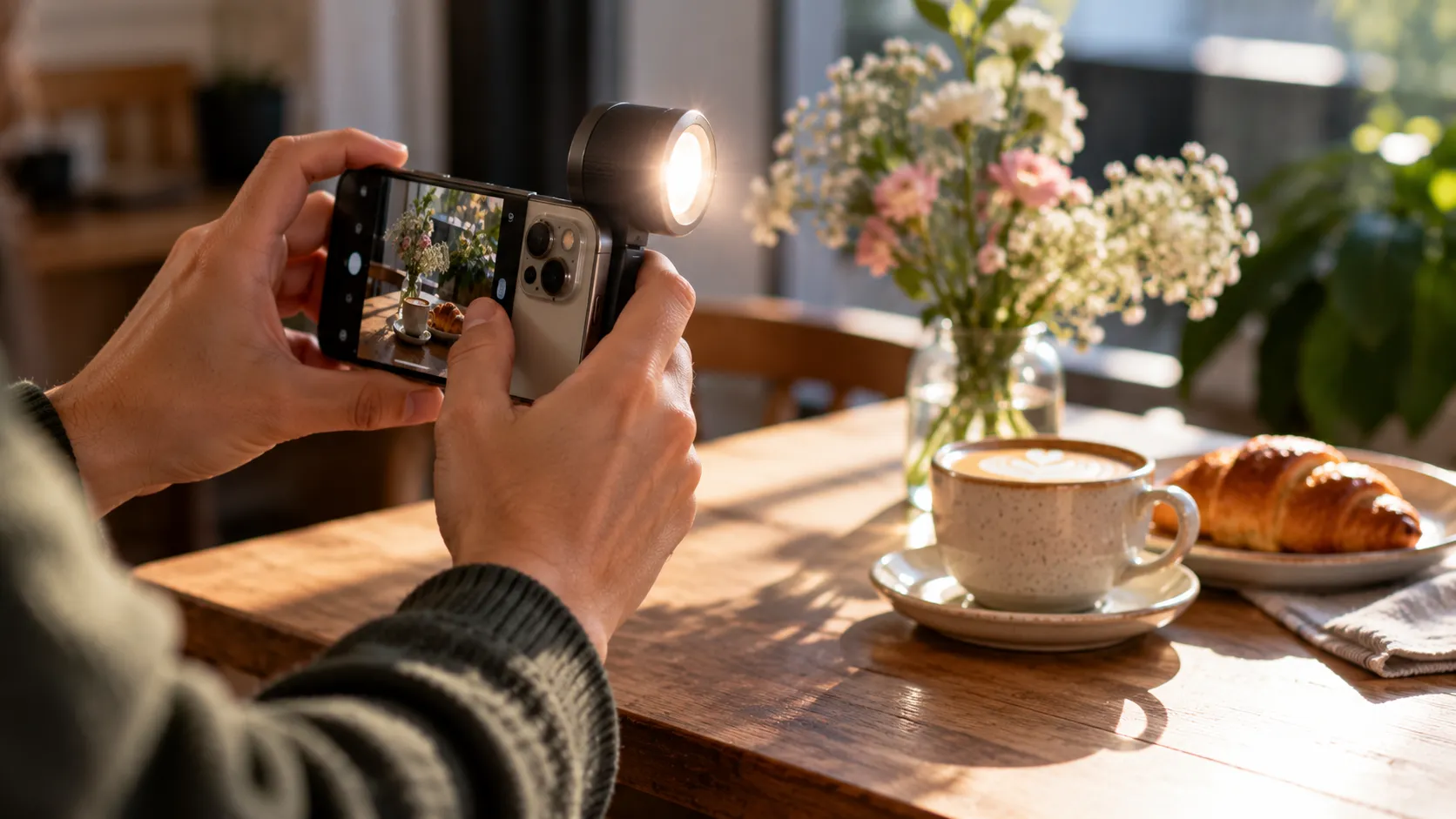
Reports describe the iPhone 18 Pro as potentially allowing users to manually shift aperture settings, framed by one source as similar to controlling aperture on a DSLR (MacRumors). The depth-of-field control this enables sharper subject isolation, smoother transitions at background edges would matter most for portrait work, product and food close-ups, and any subject-against-background composition where Portrait mode currently produces the artifacts described above.
What it won't do
Variable aperture won't close the gap between an iPhone and a full-frame camera. Smartphone physics keep depth of field deeper than most people expect at typical shooting distances. Even at a wide aperture, a significant portion of the scene will remain in focus because the sensor is small relative to a DSLR system. The background separation improvement is genuine; its scale is constrained by physics that haven't changed.
Apple's computational photography pipeline also isn't going anywhere. Processing will still run on every frame. Variable aperture changes what that pipeline receives as input it doesn't replace the pipeline.
The telephoto question
A supply-chain source also claimed that both the main and telephoto lenses could feature a larger aperture (MacRumors). That claim has considerably less corroboration than the main camera reports, and should be treated as a secondary rumor rather than a likely feature. If accurate, some of these benefits would extend to zoom shots. But that's a significant "if."
The two unknowns that will matter most at launch
If the iPhone 18 Pro ships as reported, it would be the first iPhone to feature a variable aperture on its main camera (MacRumors). Every prior Pro camera upgrade better sensors, faster processing, new modes operated within the ƒ/1.78 constraint. This would change the constraint itself.
Two questions will determine how much of that actually reaches most users.
The first is aperture range. A two-stop system and a four-stop continuous system are different products. The engineering research suggests that larger sensors are better served by a continuously variable aperture with at least four distinct settings (Cambridge Mechatronics), but nothing in current reporting confirms what Apple has built. More stops mean more creative flexibility; fewer stops mean a more automated, less controllable improvement.
The second is Camera app access and for most users, this one matters more. Whether variable aperture control appears as a standard shooting option for every iPhone 18 Pro owner, or sits behind ProRAW, a manual mode, or a third-party app, hasn't been reported. The feature in the default Camera app, available to the person shooting a birthday dinner or a weekend hike, is a meaningfully different product from the same feature gated behind a professional workflow. Apple has historically made ProRAW controls available to a narrower audience than the general camera interface. If variable aperture follows that pattern, the people most likely to notice its absence are casual photographers who never open a settings menu.
The fact that variable aperture was rumored for iPhone 17 and didn't ship is worth keeping in mind not as a reason to dismiss the current evidence, but as a reminder that supply chain momentum doesn't equal a confirmed feature. The aperture range and the Camera app implementation remain unknown. Those two details will determine whether this upgrade changes the way most people take photos, or mostly shows up in teardown comparisons and DPReview benchmarks.
Either way, the most interesting moment after Apple's announcement won't be the spec sheet confirming the mechanism. It'll be the first screenshot of the Camera app showing whether Apple gave everyone the dial.


Comments
Be the first, drop a comment!