



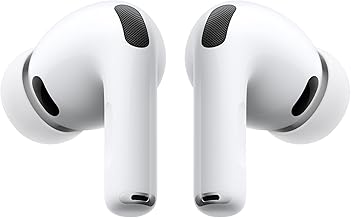


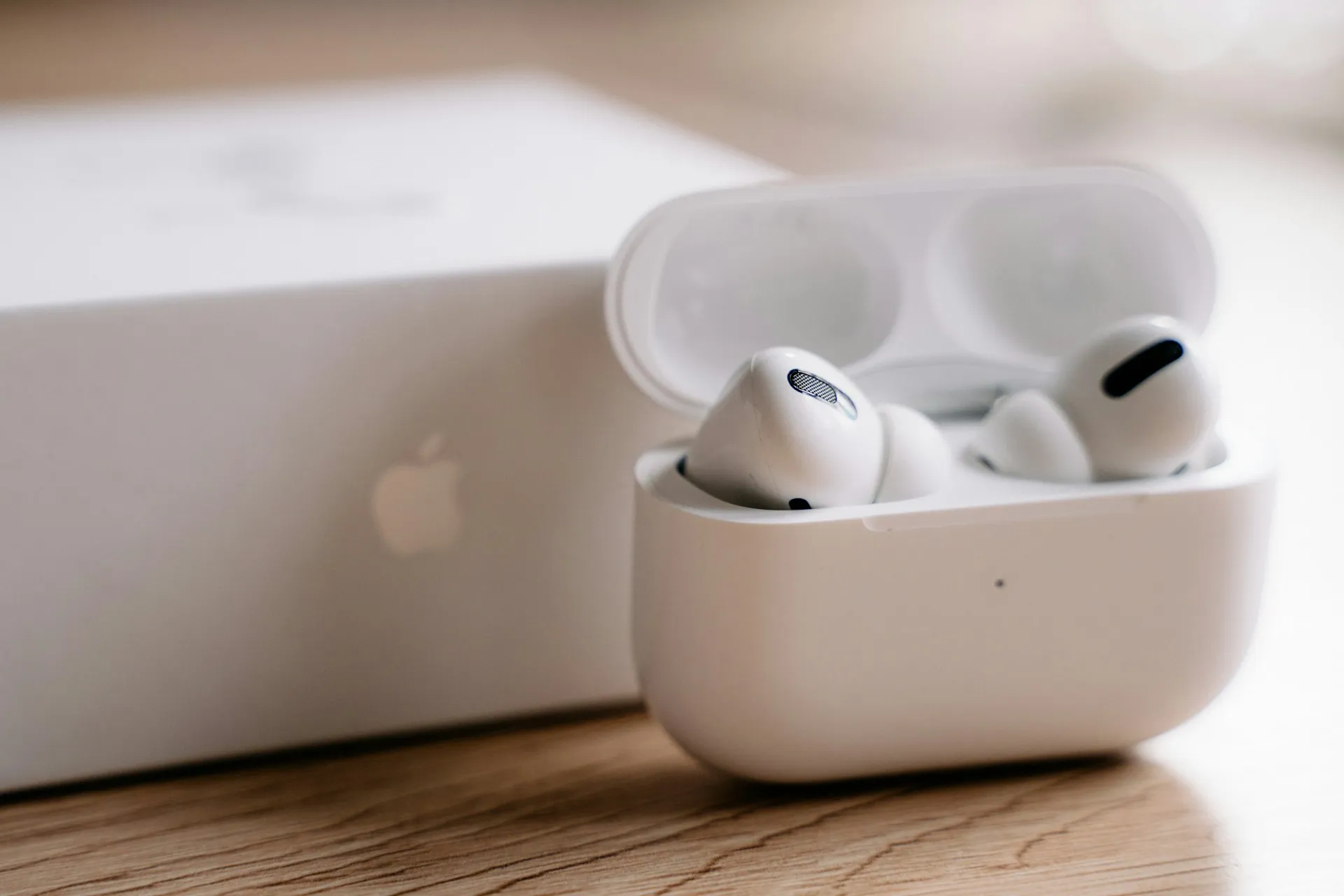
Apple's AirPods are transforming from simple audio companions into sophisticated gesture-controlled command centers. If you think the current generation's tap controls are convenient, wait until you see what Apple has in store for us by 2026.
The next iteration of Apple's popular earbuds promises revolutionary advances in motion detection and user interaction capabilities. Sources say the next generation of AirPods Pro points to AI-powered experiences, with advanced on-device processing and even camera integration on the table. We're talking about the biggest update in Apple's premium earbuds since their debut – but this evolution addresses a critical limitation: our current digital interfaces still require us to fumble with devices, interrupt our activities, or resort to voice commands that aren't always appropriate for our environment.
The H3 chip: Powering seamless interaction through advanced processing
The foundation of this transformation lies in Apple's upcoming H3 chip, a rethink of how earbuds process sound and compute on the fly. While current AirPods struggle to handle complex computational tasks without draining battery life, Apple's engineering teams are aiming far past the H2, which first appeared in 2022.
What makes the H3 revolutionary is its ability to solve the processing bottleneck that has limited gesture recognition in tiny wearables. The H3 is described as capable of handling the load of infrared camera input and advanced health monitoring at once, which sets the stage for tighter spatial audio, smarter noise cancellation, and support for Apple Intelligence features that lean on real-time context. This means your future AirPods won't just detect gestures—they'll understand the context behind them, distinguishing between intentional commands and accidental movements while maintaining all-day battery life.
The implications extend beyond individual features to create compound intelligence. Where current AirPods handle audio processing and basic sensors separately, the H3 enables real-time fusion of multiple data streams, allowing for contextual responses that feel almost telepathic in their accuracy.
Camera integration: From proximity detection to spatial awareness
Building on this processing foundation, Apple's camera integration strategy transforms earbuds into spatial computing interfaces. The most eye-catching idea on Apple's roadmap is small infrared cameras in the buds. Industry analyst Ming-Chi Kuo previously predicted at least one tiny infrared camera arriving by 2026, and rumors say Apple is actively exploring it.
These cameras could solve a fundamental interface problem: the gap between intention and action in mobile computing. Picture this scenario: you're out for a run when your favorite podcast gets too loud for the quiet street you've entered. Rather than breaking stride to find your phone, you could pause a podcast with a quick flick or nudge the volume by moving a finger near your ear while jogging.
But Apple's vision extends beyond basic hand tracking. Apple has filed multiple patents outlining how these cameras might double as proximity sensors, checking fit in the ear, and picking up defined hand gestures for control. This creates a layered system where cameras simultaneously ensure optimal audio delivery through fit detection, recognize intentional gestures, and ignore accidental movements—all while building a spatial understanding of your immediate environment for enhanced audio experiences.
Advanced skin vibration and facial gesture detection
Apple's research into biological sensing represents perhaps one of the most ambitious leaps in human-computer interaction. Where camera-based systems excel at detecting external movements, Apple is developing technology to sense the subtlest internal signals from your body itself.
Apple's patent describes a setup involving a Vertical Cavity Surface Emitting Laser (VCSEL) paired with a sensor, similar to the tech used in Face ID. This isn't simply repurposed Face ID technology—it's a completely reimagined application that addresses scenarios where traditional gesture control fails.
Apple aims to use self-mixing interferometry, a type of optical sensing, to track vibrations in the skin or minor deformations caused by facial movements. The technical implementation reveals Apple's attention to different usage contexts: the combination of VCSEL and sensor would direct a beam of light towards areas like the cheek or jaw, and changes in reflected light would be interpreted as movement caused by speech or facial gestures. For in-ear designs, the light could be directed toward the inner ear, and slight shifts in ear skin or underlying muscles would trigger the sensor.
This biological sensing capability unlocks entirely new interaction paradigms. This technology allows for discreet commands and user authentication, especially in situations where speaking aloud is impractical. Imagine controlling your devices during important meetings, in libraries, or in any situation where maintaining social etiquette requires silence—all through imperceptible muscle movements.
Expanding head gesture capabilities through contextual intelligence
Apple's head gesture evolution demonstrates how individual capabilities combine to create more sophisticated user experiences. Apple made its first notable move in this direction in 2024, when AirPods Pro began supporting head gestures, nods to accept calls, and shakes to decline, but this was merely laying the groundwork for contextual gesture recognition.
Future capabilities build on this foundation to create environmentally aware responses. Apple is said to expand head gestures to include Conversational Awareness volume adjustment. This means your AirPods could automatically lower the media volume when a person's voice is detected, via a head gesture, creating natural interaction patterns that adapt to social contexts rather than requiring conscious control decisions.
The smart features represent Apple's move toward predictive device behavior. Sleep detection capabilities could detect when a user has fallen asleep while wearing their AirPods and automatically pause playback, while camera control integration means users may be able to toggle camera control by pinching the AirPods' stem, transforming earbuds into universal remote controls for the entire Apple ecosystem.
For content creators, Apple has been developing a similar "studio quality" mic mode for AirPods, turning them into a strong competitor in the creator lav mic market, positioning these devices as professional tools that eliminate the need for specialized equipment.
Ecosystem integration: Building the foundation for ambient computing
These individual advances combine to support Apple's broader vision of ambient computing—technology that responds to natural human behavior without requiring conscious device management. Future AirPods with IR cameras could use the tech to recognize hand gestures or to work with other wearables like Apple's Vision Pro. But the real transformation occurs when these capabilities work together across Apple's entire product lineup.
These new AirPods may also work with other wearables, such as the Apple Watch or future products that Apple is reportedly working on, including smart glasses. This ecosystem integration addresses one of computing's persistent challenges: the cognitive overhead of managing multiple devices and interfaces. Instead of learning different control methods for each device, future users could employ consistent gesture vocabularies that work across platforms.
The spatial audio enhancements reveal how ecosystem thinking compounds individual features. With IR cameras, AirPods may be able to detect movement, such as when a wearer moves their hand, to control audio volume or perform tasks like changing music tracks. When combined with Vision Pro integration, Apple may use the cameras to adjust audio when a user moves their head while watching a video or emphasize audio in parts of a physical space.
Apple's research demonstrates the technical viability of this vision. Their vision-based gesture customization research achieved up to 94% average recognition accuracy from one demonstration, suggesting that future AirPods could learn and adapt to personal gesture preferences with unprecedented speed and accuracy. This isn't just about recognizing predefined commands—it's about creating personalized interaction languages that evolve with individual users.
The result is a computing paradigm where the interface disappears, replaced by natural human movement and intention. As we approach 2026, Apple appears to be positioning AirPods not just as audio accessories, but as the primary bridge between human consciousness and digital capability—tiny devices that understand not just what we want to do, but how we naturally want to do it.







Comments
Be the first, drop a comment!