





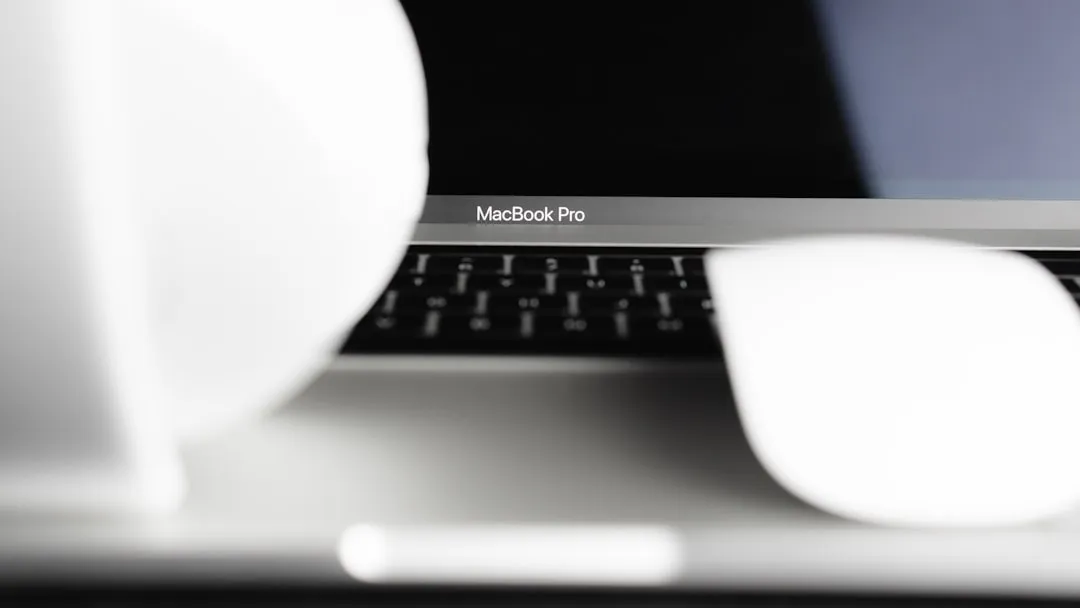
2026 is shaping up to be a watershed year for Apple, and if you're like me, you've probably been watching all the rumors and leaks with a mix of excitement and skepticism. Industry analysts are predicting major product launches that could fundamentally change how we think about Mac computers. While we're all holding our breath for that rumored touchscreen MacBook Pro that could enter mass production by late 2026, there's something pretty interesting happening right now recently announced that caught my attention.
Enter the LapTouch accessory—a clever little device that promises to give your current MacBook touch capabilities before Apple officially makes the leap. It's one of those "why didn't I think of that?" solutions that lets us answer a crucial question: what will touch interaction actually feel like on Mac, and how should we prepare our workflows for this inevitable shift?
Meet the LapTouch: bringing touch to your current MacBook
Here's what makes the LapTouch genuinely intriguing—it's not trying to reinvent your entire laptop. Instead, this compact device sits along the bottom edge of your MacBook's display, positioning itself in that little space just above your keyboard where your palms might naturally rest anyway.
The engineering approach is surprisingly elegant. Rather than requiring you to buy a completely new machine, the LapTouch uses light detection technology to sense hand and finger movements, connecting via USB-C to transform any non-touch macOS laptop into something that feels surprisingly modern. The whole setup process seems refreshingly straightforward—plug it in, let it calibrate, and suddenly your screen responds to touch gestures.
At $159, or roughly £120/AU$245, it occupies an interesting price point for early adopters. For context, that's less than what many of us spend on a decent external monitor or high-end mouse, yet it potentially transforms your entire computing experience. More importantly, it offers something Apple's future touchscreen MacBooks won't: the ability to experiment with touch workflows on your current machine, giving you months to discover which gestures actually improve your productivity before committing to a hardware upgrade.
Why Apple's official touchscreen Mac matters more than ever
Now here's where the timing becomes strategically significant. Credible reports suggest Apple's first touchscreen MacBook Pro is widely rumored to debut in late 2026 or early 2027 and to use an M6-class chip, marking a historic shift in Apple's laptop strategy—something the company has resisted for over a decade while Windows PCs embraced touch interfaces.
These aren't just going to be regular MacBooks with touch screens slapped on. The reports indicate these devices will feature OLED displays with on-cell touch technology, which means touch detection is built directly into the display layers rather than added as a separate component. This technical approach delivers more precise touch sensitivity, better palm rejection, and potentially improved battery life—all critical factors for professional workflows where accidental touches could disrupt productivity.
The shift to OLED brings additional advantages that extend beyond just enabling touch. Think deeper blacks for better photo and video editing, more vibrant colors that rival professional monitors, and potentially improved battery life compared to current Mini LED displays. When combined with touch capability, we're looking at displays that could genuinely compete with professional tablets for creative work while maintaining full macOS functionality.
What's particularly fascinating is that analysts suggest this move reflects Apple's long-term observation of tablet user behavior. Instead of following market trends, Apple has been methodically studying how professionals actually use iPads in work environments. The conclusion: direct manipulation through touch genuinely speeds up certain tasks—scrolling through timelines in video editing, precise selection in design applications, or quick navigation in complex documents where reaching out to tap is faster than trackpad navigation.
The broader ecosystem transformation happening in 2026
Apple's touchscreen Mac plans represent just one element of a comprehensive reimagining of their entire laptop strategy. The company is simultaneously developing its most affordable Mac laptop ever, potentially priced at $599-699, which would use iPhone-level processors to dramatically reduce costs.
This pricing strategy could fundamentally reshape the Mac market. We're potentially looking at a MacBook that costs less than many iPads, powered by the same chips that make iPhones incredibly capable for everyday computing tasks. The implications extend beyond just price—imagine the ecosystem integration possibilities when your laptop and phone share the same processor architecture, enabling seamless app compatibility and unified performance optimization.
Meanwhile, at the professional end, the Mac Pro may face discontinuation after its 2023 update, signaling Apple's belief that the future lies in democratizing powerful computing rather than creating ultra-premium workstations for niche markets. This strategic pivot suggests Apple sees greater opportunity in empowering creative professionals through more accessible, touch-enabled devices than in pursuing the highest-end computing performance.
The software evolution reinforces this unified approach. macOS 26 (macOS Tahoe) is rumored to take design cues from Apple Vision Pro, suggesting interface elements designed for spatial computing and direct manipulation. Picture macOS windows that respond intuitively whether you're touching them on a MacBook screen, gesturing through Vision Pro, or navigating with traditional input methods—a truly unified interaction paradigm across Apple's entire ecosystem.
What this means for Mac users today
For current MacBook owners, accessories like LapTouch offer more than just a preview of what's coming—they provide a strategic advantage in the transition to Apple's touch-enabled ecosystem. Consider the workflow adaptation opportunity: while others will need months to adjust when Apple's touchscreen MacBooks arrive, you could already be fluent in which touch gestures enhance your specific work patterns.
The practical benefits extend into concrete scenarios. In video editing, direct timeline scrubbing becomes more intuitive than precise trackpad movements. For designers, quick color palette selection or brush size adjustments happen faster through direct touch than menu navigation. Even in everyday tasks like document review, the ability to quickly scroll, zoom, and highlight through natural touch gestures can significantly improve reading and annotation workflows.
But the real opportunity lies in understanding how Apple's ecosystem evolution fundamentally reshapes productivity workflows across all devices. We're approaching a future where you might sketch initial concepts on your MacBook screen, develop them further on an iPad for detailed illustration, and present the final work through Vision Pro—all using consistent gesture languages and seamless file integration rather than distinct, disconnected experiences.
The timing decision becomes a question of adaptation strategy rather than just hardware preference. Early experimentation with solutions like LapTouch allows you to identify which touch interactions genuinely improve your productivity versus which feel like novelties. You'll enter Apple's official touchscreen era with informed preferences rather than starting from zero, having already optimized your workspace layout and gesture habits for maximum efficiency.
Bottom line: We're not just talking about adding touch capability to Macs—we're witnessing the foundation of Apple's next-generation computing paradigm. Whether you choose to experiment now or wait for Apple's integrated solution, 2026 represents a pivotal transformation in the company's hardware strategy. The question isn't whether touch will reshape Mac computing, but whether you want to be part of defining how that transformation enhances professional workflows, or simply adapting to changes others have already explored.



Comments
Be the first, drop a comment!