



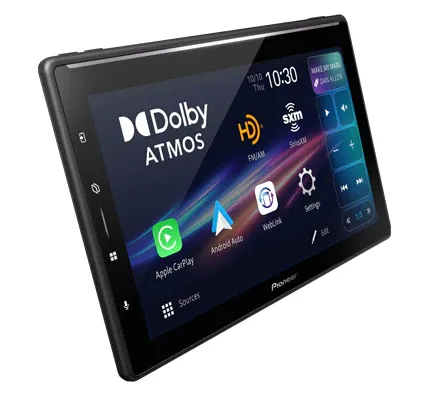
Pioneer just unveiled something that could completely transform your daily commute at CES 2026. The Sphera head unit brings Dolby Atmos spatial audio to CarPlay for the first time, and here's the truly impressive part: Pioneer claims this world-first system can create immersive spatial audio using just a basic four-speaker setup. That's right, no need for the complex multi-speaker arrays you'd find in premium theaters or high-end home systems.
The Sphera packs a 10.1-inch HD touchscreen and supports both wireless Apple CarPlay and Android Auto, making it a comprehensive upgrade that should work with most vehicles on the road today. What makes this announcement particularly exciting is how it democratizes premium spatial audio technology, bringing immersive sound experiences to mainstream car owners without requiring expensive, complex installations.
How Pioneer makes spatial audio work with just four speakers
This is where Pioneer's engineering gets genuinely fascinating. The breakthrough comes through their Pure Autotuning technology, which Pioneer developed specifically for vehicle interiors. Every car cabin presents unique acoustic challenges—different sizes, shapes, materials, plus aftermarket modifications that can throw additional variables into the mix.
Pioneer's solution handles all of this automatically. The system precisely adjusts time alignment, frequency response, and channel levels to optimize performance and place the listener at the acoustical center position. Instead of requiring speakers mounted in challenging vertical spaces like your headliner or roof, Pioneer creates a virtual sphere of sound that puts you right in the acoustic sweet spot.
What sets this apart from traditional Atmos implementations is the simplified approach to installation and hardware requirements. Pioneer's system significantly reduces installation complexity by eliminating the need for speakers in vertical spaces, and uses only four discrete amplifier channels while still delivering that immersive Atmos experience. Where other systems might demand 16, 20, or even more speakers, Pioneer achieves spatial audio with a practical configuration most car owners can actually implement.
Tony Verni from Pioneer explains that this is a proprietary system developed specifically for automotive applications rather than adapting home audio technology. That distinction matters because car interiors present unique acoustic challenges—road noise, irregular surfaces, and proximity to the listener—that home systems never have to address.
What the listening experience actually delivers
The early feedback from audio professionals suggests Pioneer has solved a genuinely difficult technical challenge. Industry experts who've experienced the system firsthand describe the music as more "fun" and dynamic, with sound that seems to move both vertically and horizontally around the dashboard.
Dean Beyett from Five Star Car Audio and the popular Dean and Fernando YouTube channel put it this way: The difference is "dramatic" and comparable to experiencing surround sound at home for the first time. He specifically mentioned how in "Rocket Man," it actually sounds like a rocket going over your head—that's the kind of spatial positioning that makes Atmos so compelling.
The magic happens through Dolby Atmos "objects" that can be positioned anywhere in the sound stage. Think of these as individual audio elements that recording engineers can place precisely in three-dimensional space. The Dolby software then adapts these objects to work with whatever speaker configuration is available, determining how many channels you have and optimally distributing the audio elements for maximum spatial impact.
Robert Mony from Pioneer explains that "with the Atmos experience, we must think differently. The Atmos processes sounds into objects at the processor level"—it's a totally new approach from traditional channel-based audio systems that transforms how spatial information is processed and delivered.
Why this matters for the Apple ecosystem
The timing of Pioneer's announcement aligns perfectly with Apple's automotive ambitions. CarPlay Ultra launched in May 2025 with enhanced features including multi-display support, deeper vehicle integration, and access to climate controls. Currently available in Aston Martin vehicles with plans to expand to other manufacturers, CarPlay Ultra represents Apple's most comprehensive automotive platform yet, featuring widget functionality, FM radio support, and extensive integration with vehicle systems.
What makes this particularly compelling for Apple users is the seamless ecosystem integration. Dolby emphasizes that making the transition from mobile entertainment to in-car entertainment seamless is crucial for consistent audio experiences. This addresses a real frustration - you might enjoy Apple Music's spatial audio on your iPhone, but lose that immersive experience the moment you connect to your car's audio system.
By enabling streaming from phones, users gain wider access to Dolby Atmos content that was previously limited to services integrated directly into vehicles. Pioneer's breakthrough is that this solution can be applied to almost any vehicle with CarPlay support, effectively bringing premium spatial audio to a huge range of existing vehicles through aftermarket upgrades.
What this means for car audio's future
Pioneer's innovation arrives during a rapid industry transformation. Dolby Atmos support among automakers has doubled in the past year, growing from 10 to over 21 manufacturers, including Cadillac, Rivian, Mercedes-Benz, Polestar, and Volvo. Simultaneously, the content ecosystem has expanded across major streaming platforms, including Apple TV+, Amazon Prime Video, Disney+, Netflix, Paramount+, and VUDU, ensuring there's substantial content to take advantage of these new automotive systems.
Pioneer plans to bring this solution to market quickly and may offer it for both aftermarket and OEM applications. That dual approach could be transformative - imagine getting this technology not just as an upgrade for your current vehicle, but potentially built into new cars from the factory.
The broader implications are fascinating. If Pioneer can deliver genuine Dolby Atmos experiences with practical four-speaker configurations, it removes the biggest barrier to mainstream adoption - installation complexity and cost. No need to tear apart your headliner, figure out where to mount height channels, or invest in extensive amplification. Just replace your head unit and upgrade your existing speakers.
The Sphera will be available starting this spring with a starting price of $1,300 in the US, though UK pricing hasn't been announced yet. For context, that's competitive with high-end aftermarket head units that lack Dolby Atmos capability, making this potentially excellent value for the technology leap it represents.
Bottom line: Pioneer appears to have solved one of automotive audio's most challenging puzzles—delivering immersive spatial audio in the acoustically difficult, constrained environment of a car cabin using a speaker configuration that's actually practical for most people to implement. For Apple ecosystem users who've gotten accustomed to spatial audio on their devices, this could finally extend that premium listening experience to their daily commute. The question now isn't whether this technology will succeed, but how quickly the rest of the industry will respond to what Pioneer has accomplished.





Comments
Be the first, drop a comment!