





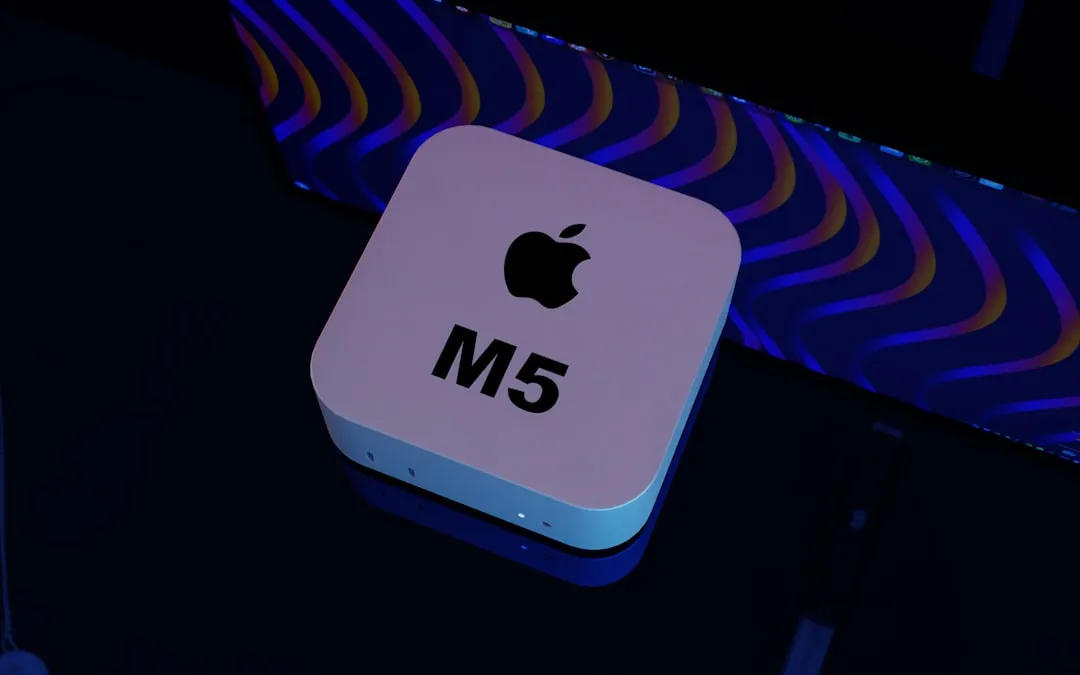
Apple's latest M5 Max MacBook Pro has achieved something that seemed impossible just a few years ago – a laptop processor decisively outperforming a desktop-class chip with nearly twice as many cores. The first verified Geekbench results reveal the M5 Max achieving a multi-core CPU score of 29,233, which tops the 27,726 score achieved by the Mac Studio's M3 Ultra chip, marking a fundamental shift in the performance hierarchy of consumer computing.
This achievement becomes even more remarkable when you consider the engineering constraints involved. The M3 Ultra enjoys the luxury of a desktop Mac Studio chassis with active cooling and generous thermal headroom, yet the M5 Max delivers roughly 5% better CPU performance while operating within the tight thermal envelope of a laptop. This breakthrough stems from Apple's innovative Fusion Architecture approach, which combines two dies into a single system on a chip, fundamentally changing how portable computers can compete with their desktop counterparts.
Breaking down the M5 Max's record-setting performance
The secret behind the M5 Max's dominance lies in its revolutionary 18-core CPU architecture that prioritizes intelligent design over brute-force scaling. Apple's approach centers around six "super cores" that are the world's fastest CPU core design working in harmony with twelve newly designed performance cores specifically optimized for multi-threaded workloads.
Here's where Apple's naming gets a bit confusing – and honestly, they could have handled this better. The "super cores" are essentially the same as the regular M5's performance cores, just rebranded. The real innovation comes from the new "performance cores" in the Pro and Max variants, which represent a third type of core design, distinct from both the super cores and the regular M5's efficiency cores. These cores prioritize multi-threaded efficiency over single-core speed, creating a more balanced approach to professional workloads.
This architectural sophistication translates directly into benchmark dominance. The M5 Max's single-core performance reaches 4,268 points, which is the highest single-core score of any consumer PC processor ever, surpassing even AMD's flagship Ryzen 9 series. For video editors working with complex timeline scrubbing or developers running single-threaded compilation tasks, this translates to noticeably snappier performance than any competing consumer processor.
The multi-core results showcase how this new architecture delivers up to 30 percent performance boost for pro workloads compared to the previous generation. For professionals running parallel rendering tasks, batch photo processing, or complex scientific simulations, this means significantly shorter wait times and more responsive multitasking.
GPU performance that challenges desktop boundaries
The graphics capabilities tell an equally compelling story, positioning the M5 Max as a genuine desktop replacement for creative professionals. The 40-core GPU configuration delivers Metal benchmark scores ranging from 218,772 to 232,718 points in early testing. While these scores fall 5% to 10% lower than the highest-end M3 Ultra's average Metal score of 245,053, they represent a substantial leap forward that puts the chip within striking distance of desktop-class graphics performance.
The generational improvement becomes clear when comparing the M5 Max to its predecessor. The new chip delivers more than 20% higher GPU performance than the M4 Max's average Metal score of 191,600, which translates to tangible benefits for 3D artists, game developers, and anyone working with GPU-accelerated applications. For Motion Graphics artists using Cinema 4D or architects rendering complex scenes, this 20% boost means the difference between coffee break renders and full lunch break waits.
Perhaps most exciting are the predictions for peak performance configurations. Estimated scores could reach over 250,000, potentially making it the first Apple GPU to break this barrier. If these numbers hold up in real-world testing, we're looking at performance levels approaching some mid-range desktop GPU benchmarks dedicated NVIDIA RTX 4070 graphics cards – integrated into a laptop that you can actually carry on a plane.
The M5 Max also represents a significant leap forward for AI workloads. With a Neural Accelerator in each GPU core and higher unified memory bandwidth, the M5 Max delivers over 4x the peak GPU compute for AI compared to the previous generation. This isn't just about traditional graphics rendering – it positions these machines as serious tools for machine learning practitioners, content creators using AI-powered effects, and developers building intelligent applications.
The thermal envelope advantage: laptop beating desktop
What makes the M5 Max's victory over the M3 Ultra particularly impressive is the engineering challenge Apple has solved around thermal management. Desktop processors have traditionally held the performance crown because they can dissipate heat more effectively through larger heatsinks and active cooling systems. The M3 Ultra benefits from the Mac Studio's generous thermal envelope, yet the M5 Max exceeds its CPU performance while operating within the constrained thermal budget of a laptop.
The breakthrough comes from Apple's Fusion Architecture approach, which represents a fundamentally different design philosophy than simple scaling. Rather than just welding two M5 chips together, Apple uses one chiplet handling the CPU and most of the I/O, and a second one that's mainly for graphics, both built on the same 3nm TSMC manufacturing process. This separation allows for more precise thermal management, as heat-generating components are distributed across the chip package rather than concentrated in a single hotspot.
The first silicon die remains consistent whether you choose an M5 Pro or M5 Max configuration, enabling Apple to optimize thermal characteristics with surgical precision. This chiplet approach means that CPU-intensive tasks won't necessarily throttle GPU performance and vice versa, providing more consistent sustained performance for mixed workloads.
Supporting this thermal efficiency is the M5 Max's impressive memory subsystem, which maxes out at over 614 GB/s of unified memory bandwidth. This massive throughput reduces the time processor cores spend waiting for data, translating to better performance per watt and more efficient power usage – critical factors when operating within laptop thermal constraints.
Real-world implications and benchmark caveats
While these benchmark numbers paint an impressive picture, it's crucial to understand their limitations and what they mean for actual professional workflows. These early results come from a Mac17,7 model corresponding to the upcoming 16-inch MacBook Pro, representing a single data point rather than comprehensive testing across various conditions.
The performance improvements align closely with Apple's marketing claims, with the M5 Max offering up to 15% faster CPU performance and up to 20% faster GPU performance compared to the M4 Max. For professionals evaluating upgrade decisions, these figures suggest meaningful improvements across both computational and graphics workloads.
However, the distinction between peak and sustained performance remains crucial for professional workflows. Geekbench measures burst performance over relatively short durations, while real-world professional tasks like 8K video exports, extensive 3D rendering, or lengthy code compilation sessions stress systems differently. Video editors working on feature-length projects or 3D artists rendering animation sequences may still see benefits from the Mac Studio's superior sustained cooling, particularly during marathon work sessions.
The laptop form factor will always face thermal physics limitations that don't constrain desktop machines. For workflows that involve hours of continuous high-load processing, the desktop Mac Studio may maintain higher average performance even if the M5 Max achieves higher peak scores. Understanding your specific workflow patterns – whether they involve short bursts of intensive work or sustained heavy loads – becomes key to choosing the right machine.
What this means for the future of portable computing
These benchmark results represent more than impressive numbers – they signal a fundamental disruption of traditional computing hierarchies. The M5 Max is now the fastest Apple silicon chip ever, and it even topped every other consumer PC processor in the Geekbench database, establishing new expectations for what constitutes "desktop-class" performance.
This shift creates entirely new possibilities for professional workflows previously tethered to desktop workstations. Video editors can now handle 8K multicam projects on location, 3D artists can work with complex scenes during client meetings, and developers can run comprehensive build processes while commuting. The implications extend beyond individual productivity to reshape entire industries – film productions could operate with smaller technical footprints, architectural firms could present complex visualizations on-site, and research teams could run computational models in the field.
The competitive landscape implications are equally significant. If Apple can deliver desktop-surpassing performance in a laptop while maintaining reasonable battery life and thermal characteristics, it challenges fundamental assumptions about mobile versus desktop computing value propositions. Other chip manufacturers now face pressure to rethink their own architectural approaches, potentially accelerating innovation across the entire industry.
However, the true test of this performance revolution will emerge when these machines reach professional users' hands. Extended real-world testing will reveal whether these benchmark victories translate into practical advantages for demanding workflows, how battery life holds up under professional loads, and whether thermal management maintains performance consistency across various use cases. Early indicators suggest a promising future where the choice between desktop and laptop performance becomes less about capability and more about specific workflow requirements and personal preferences.
The M5 Max appears to represent a genuine inflection point – the moment when laptop processors didn't just catch up to their desktop counterparts, but surpassed them entirely. If these results hold up to scrutiny, we're witnessing the beginning of a new era in portable computing power.










Comments
Be the first, drop a comment!