



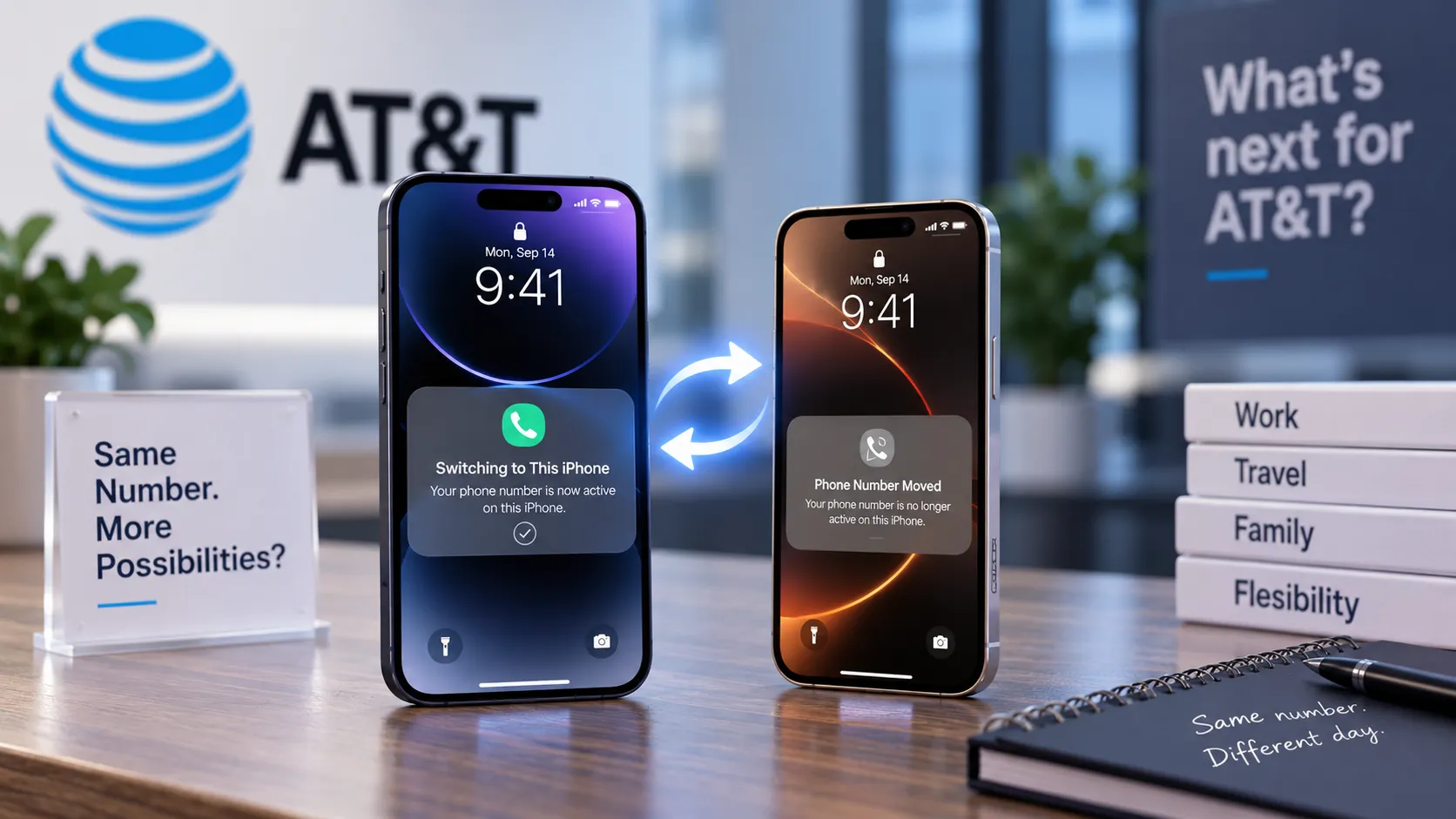
AT&T iPhone Handoff support remains unconfirmed.
Asked directly whether AT&T will support Apple's new iPhone Handoff feature, a company spokesperson pointed customers toward AT&T's existing eSIM activation and transfer options instead of naming a rollout timeline, 9to5Mac reported on September 23.
MacRumors reported the same AT&T response that day.
iPhone Handoff needs a carrier to build support for it on its own network. Apple can't simply switch it on for every iPhone owner.
T-Mobile is currently the only US carrier Apple lists as supporting the feature, which means AT&T customers can't use iPhone Handoff on an AT&T line based on what's confirmed today.
Does AT&T Support iPhone Handoff?
Not currently.
A spokesperson said AT&T sees "potential in capabilities like iPhone Handoff," but added that the carrier's focus "remains on delivering innovations that make life simpler and keep customers connected with confidence," according to 9to5Mac.
Rather than name a launch date, AT&T pointed customers toward its "existing eSIM activation and transfer options across compatible devices."
MacRumors characterized AT&T as noncommittal about Handoff, with no announced support date.
That wording doesn't rule out support later, but it doesn't promise it either.
Anyone tracking AT&T iPhone Handoff availability is left with a carrier that acknowledges the feature's potential without committing to a rollout.
What iPhone Handoff Does, and How It Differs From AT&T's eSIM Transfer Options
iPhone Handoff lets one phone number be configured across two compatible iPhones, but only one iPhone is active on the cellular network at a time.
Apple's current documentation says unlocking one of the paired iPhones makes it active automatically while the other becomes inactive.
Calls, voicemail, messages, Find My location, and other supported iCloud-synced information follow whichever iPhone is currently active.
That's different from the normal eSIM transfer process AT&T points customers toward.
With a standard eSIM transfer, the number moves from the old iPhone to the new one. Apple says the number then stops working on the previous iPhone.
With iPhone Handoff, both phones remain configured for the same number so you can switch back and forth simply by unlocking the device you want to use.
The distinction is persistent two-device setup versus a one-way transfer, not two simultaneously active phones.
Handoff doesn't remove the normal replacement process either.
If one of the paired iPhones is being replaced permanently, the appropriate eSIM still needs to be set up on the replacement device.
iPhone Handoff Supported Carriers Today
Apple currently lists two participating carriers:
United States: T-Mobile
Germany: Telekom
T-Mobile charges $5 per month for iPhone Handoff.
Apple has said Verizon in the US and EE in the UK will add support by the end of 2026, with more carriers to follow.
Neither AT&T nor Apple has announced an AT&T launch date.
Pricing on future carriers also hasn't been disclosed, so T-Mobile's $5 fee shouldn't be treated as an industry-standard price.
Carrier support is the gatekeeper.
Two compatible iPhones running iOS 27 don't gain Handoff simply because the software supports it. The cellular carrier also has to participate.
What You Need Before iPhone Handoff Can Work
Where a carrier supports Handoff, Apple requires two iPhones running iOS 27 or later.
The devices also need to:
Be connected to Wi-Fi during setup.
Use the same Apple Account.
Have Messages in iCloud enabled.
Be signed in to FaceTime and iMessage with the same Apple Account.
Use an eSIM from a carrier that supports iPhone Handoff.
After setup, one device becomes the main iPhone and the other becomes the secondary iPhone sharing the number.
Apple recommends making the phone you use most often the main device.
Some carrier controls, including Call Forwarding, Caller ID, and carrier account management, can be managed only from that main iPhone.
None of those requirements matter for an AT&T line yet because AT&T hasn't announced network support.
AT&T's Existing eSIM Transfer Isn't the Same Feature
AT&T already supports transferring an eSIM and phone number between compatible iPhones.
Its current eSIM transfer instructions let customers move a number from a nearby iPhone during or after setup.
That process is useful when upgrading from one phone to another.
It isn't iPhone Handoff.
Apple's standard transfer documentation makes the difference explicit: once a number is transferred to a new iPhone, it stops working on the old one.
iPhone Handoff leaves both devices configured so the active number can switch between them later.
That makes AT&T's existing eSIM tools a solution for moving service to another phone, not a replacement for Apple's new switch-back-and-forth feature.
AT&T Already Has Another Multi-Device Service
AT&T also offers NumberSync, which can extend a smartphone number to supported secondary devices such as smartwatches and tablets.
That still isn't the same thing as iPhone Handoff.
AT&T describes NumberSync as a way to make and receive calls or messages from supported secondary devices using the smartphone's number, including when the primary phone isn't nearby.
iPhone Handoff is specifically designed around switching the active cellular identity between two iPhones.
The existence of NumberSync therefore doesn't establish that AT&T already supports Apple's new feature under another name.
A Naming Mixup Worth Clearing Up
AT&T's support site also has pages describing something simply called Handoff, but those cover Apple's older Continuity feature.
That Handoff lets someone start a task on one Apple device and continue it on another.
For example, you can begin writing an email on an iPhone and continue it on an iPad or Mac.
AT&T's Continuity guide tells users to sign in with the same Apple Account, enable Bluetooth, and connect the devices to Wi-Fi.
That's unrelated to the new carrier-dependent iPhone Handoff introduced in iOS 27.
The shared name makes search results confusing, but the features solve completely different problems.
Why AT&T's Position Matters
For AT&T customers, the limitation isn't the iPhone itself.
Apple's software can support Handoff, but the carrier has to provision the companion eSIM and network behavior needed to move the number between two phones.
Until AT&T does that, buying a second compatible iPhone doesn't create the feature.
That matters particularly for people considering combinations such as an iPhone Duo and a conventional iPhone Pro.
A customer might want the same number available whichever phone they decide to carry that day, but switching to the other device through AT&T currently means using the carrier's ordinary eSIM-transfer process rather than Handoff.
What to Do Now
Anyone simply upgrading to a new iPhone can continue using the eSIM activation and transfer options AT&T already supports. iPhone Handoff isn't required for a normal device upgrade.
Anyone who wants one number configured across two iPhones with automatic switching between them needs a participating carrier.
Today, Apple lists T-Mobile in the US and Telekom in Germany.
Verizon and EE are expected to join by the end of 2026.
AT&T hasn't announced a rollout date of its own.
If you're staying with AT&T, the practical option is to wait for an official carrier announcement rather than assuming support is coming on a particular schedule.
If Handoff itself is important enough to influence a carrier decision, compare the pricing, coverage, plan terms, and Handoff conditions of a carrier that actually supports it before switching anything.
And don't confuse Handoff with simultaneous service on two phones. Apple's design keeps the same number configured on both devices, but only one iPhone is active on the cellular network at a time.



Comments
Be the first, drop a comment!