




Code buried inside a macOS Tahoe 26.7 update shows how Apple's rumored Home Hub might figure out who's standing in front of it. The strings describe ambient sensing, built-in cameras, and possibly voice cues working together to verify a person's identity and then switch to that person's own profile. MacRumors reported the find, and AppleInsider spotted matching code in the same build, which it describes as a 26.7 release candidate.
The code calls the feature Personal Content. It's designed to surface different calendars, notes, and information depending on who's using the device, according to that code and Bloomberg reporting relayed by Biometric Update earlier this month. It's a rare, concrete look at how Apple's long-rumored smart display might personalize itself for an entire household. What the code doesn't settle is how much of that personalization happens on its own, without anyone asking the device to check who they are.
What the Apple Home Hub ambient sensing code actually shows
Personal Content looks like a per-user setting rather than a system-wide one. Users turn it on in the Settings app by tapping their name, then pick their own profile from Control Center to load it, according to both MacRumors and AppleInsider.
Several prompts tie access to a camera check. One reads: "Sorry, since this device hasn't seen you in a while, you'll need to ask again in front of the camera." Another frames ambient sensing as something a user "temporarily allows" while confirming identity through Control Center, per MacRumors.
A separate string, "I'm not sure who's speaking. Please come in front of this device and ask again," pairs a voice cue with a request to step in front of the camera. That's narrower than voiceprint identification. It reads more like a trigger for a visual check than a claim that the hub recognizes people by voice alone.
There's also a manual fallback: "Sorry, I'm not sure who you are... you'll need to select yourself in Control Center." That string confirms the system asks for manual input rather than guessing when it can't confirm someone's identity.
Put together, the two reports establish a modest, specific set of facts: Personal Content exists as a named feature, profile access runs through Control Center, and the build contains prompts for camera checks, an unidentified-speaker warning, and manual selection. What isn't established is whether profiles switch automatically without a prompt. MacRumors notes that the mentions of ambient sensing suggest the hub could switch profiles automatically using some combination of cameras and sensors, but that's the outlet's read of the language, not a confirmed mechanism. Nothing in the strings names facial recognition specifically as the technology doing the work.
Rumored hardware and the Apple Home Hub personalization questions still unanswered
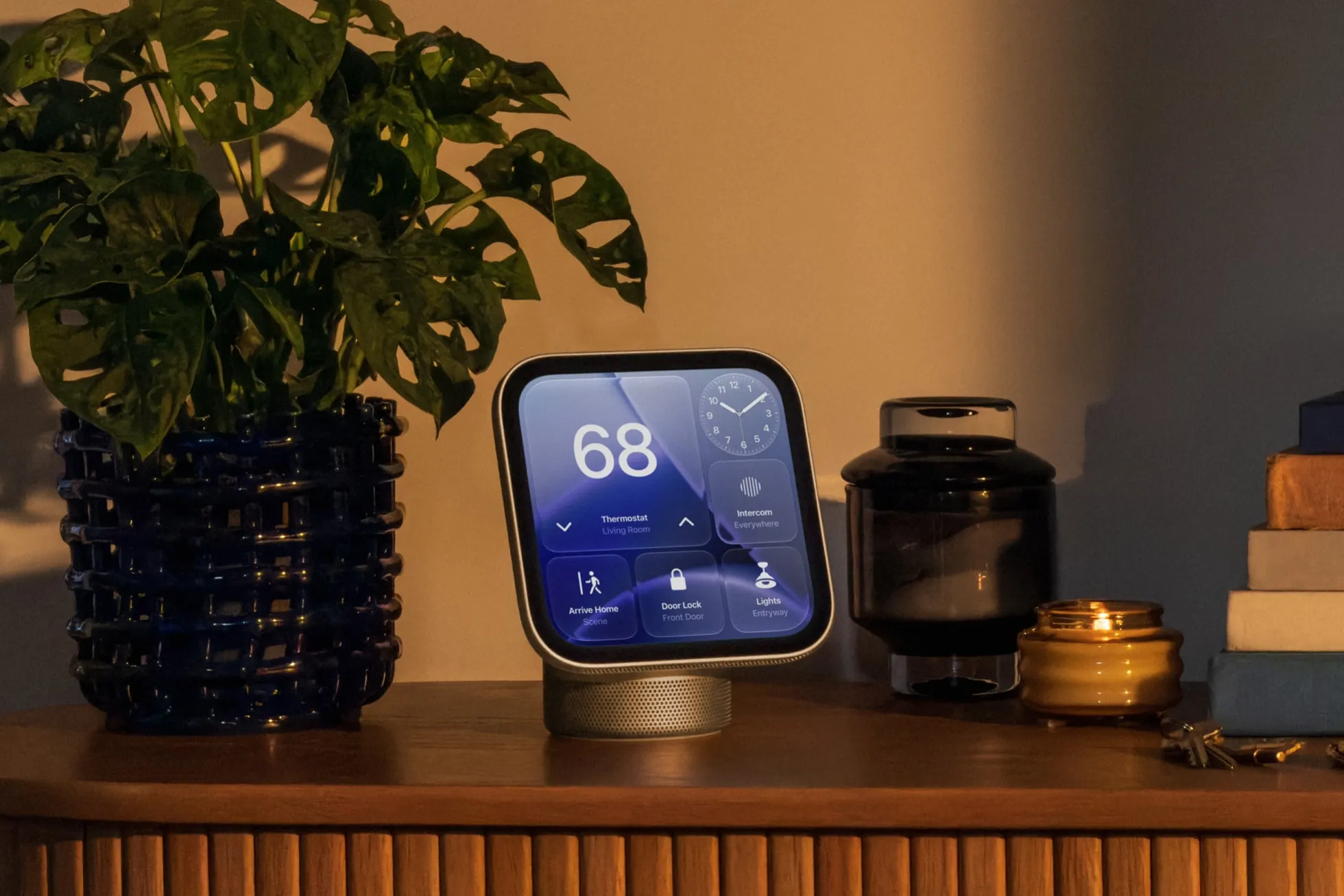
The build also contains identifiers for two hardware variants: J490, described as a speaker-base model, and J491, a wall-mounted one, alongside descriptors that appear to label both as "HomeAccessory" and "HomeAccessory_wall," according to AppleInsider. Bloomberg reportedly said the device could ship with a seven-inch display that estimates how far a person is standing and resizes on-screen information accordingly, per Biometric Update. The same reporting says it's expected to handle FaceTime calls, smart home controls, security camera monitoring, and an intercom, positioned as the main screen for Apple's connected-home ecosystem.
Apple's existing HomeKit Secure Video system offers a useful comparison, and a cautionary one. It already analyzes footage on-device to flag people, pets, and cars, but it can also store that encrypted footage in iCloud for iCloud+ subscribers, according to Apple's support documentation. On-device analysis, in other words, doesn't by itself tell you where the data ends up afterward. Apple hasn't said whether a future Home Hub would follow that model or something different.
The rest sits firmly in rumor territory. Bloomberg reported a release window between October 2026 and early 2027, not a fixed date, per Biometric Update. A higher-end nine-inch model with a robotic arm that repositions the screen is also reportedly in development, according to the same reporting.
Home Hub ambient sensing revives an old biometric-consent problem
Apple's strongest legal precedent for handling faces on a personal device came from a 2022 Illinois appellate ruling. In Barnett v. Apple, the court found that Face ID didn't violate the state's Biometric Information Privacy Act, reasoning that the data never left the phone's Secure Enclave and that a person captures their own face on their own device and can delete it anytime, according to Forkast, which covered the case last month.
A hub sitting in a shared kitchen doesn't fit that reasoning as neatly. Roommates, kids, and guests might get recognized without any of them individually enrolling anything. Researcher Travis Gilly has argued that ambient biometric devices create structural consent problems under privacy laws such as COPPA.
Google disables Nest familiar-face detection in Illinois, while Ring does not offer its Familiar Faces feature in Illinois, Texas, or Portland, Oregon, citing applicable legislation. Forkast also reported that Google and Amazon have already disabled "Familiar Face" recognition features in Illinois, Texas, and Portland after lawsuits challenged the collection of biometric data from bystanders who never consented. Google separately settled a related Texas case for $1.375 billion last year, per Forkast.
Apple already has its own version of this fight underway. A pending Illinois suit alleges that Photos' facial-grouping feature scans biometric data and syncs it across devices via iCloud without the consent BIPA requires. The plaintiffs' estimated maximum exposure, based on roughly 6.5 million class members and BIPA's damages of up to $5,000 per intentional violation and $1,000 per negligent one, runs as high as $32.5 billion, according to Biometric Update. That figure describes alleged exposure, not an established liability, but it's a preview of what a household camera feature could invite if critics' fears play out.
The logic in Barnett rested on a device that belongs to one person who chooses to enroll their own face. A shared hub could complicate that framing by design, and nothing disclosed so far explains how Apple would handle enrollment or consent for everyone else who happens to walk past it.
What to watch next
The open questions now are about policy, not hardware. How would Apple define enrollment for a household with several people? Does recognition run passively, or only after someone asks the device directly? Does the eventual announcement address bystanders and guests at all?
None of those answers live in the code. They may surface if Apple unveils the product sometime in the window Bloomberg has reported, between October 2026 and early 2027. Until then, the code shows a camera-and-voice-assisted access system built to ask before it acts, which is a meaningfully different claim than an always-watching recognition system, even if the two get described the same way once the marketing starts.



Comments
Be the first, drop a comment!