



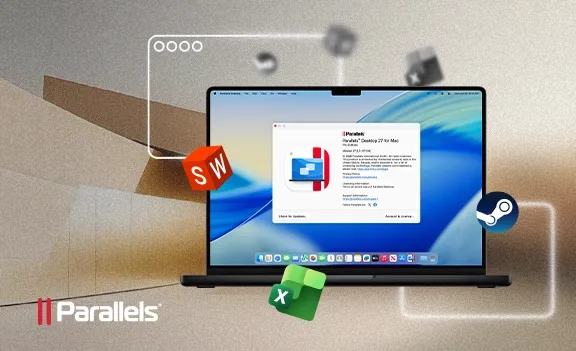
Parallels recently announced Parallels Desktop 27, adding a Metal-based graphics driver that brings hardware-accelerated OpenGL 4.3 to Windows virtual machines on Apple silicon Macs. The company describes the capability as unique among Mac virtualization tools, though that comparison comes from Parallels itself rather than independent testing.
The driver meets the minimum OpenGL requirement for three named professional applications: ArcGIS Pro, ZWCAD, and Blender 4.3. That means they can now run inside a Parallels VM on Apple silicon. It's a narrower claim than a blanket statement about Windows software being production-ready on Mac, and that distinction should shape how the rest of this release gets read.
"As customers continue to push the limits of what they do on Mac, they're looking for virtualization that keeps pace with increasingly demanding applications and workflows," Elena Koryakina, Parallels' chief product and technology officer, said in the announcement.
Parallels says it remains the only third-party virtualization solution currently authorized by Microsoft to run Windows in a virtualized environment on Apple silicon.
What's new: a Metal-based driver adds OpenGL 4.3 to Windows VMs
The new driver delivers hardware-accelerated OpenGL 4.3 in Windows virtual machines on Apple silicon Macs. Parallels frames it as both a compatibility fix and a performance upgrade.
OpenGL 4.3 isn't a performance benchmark. It's the minimum graphics level many professional Windows applications need just to open and run.
Three named applications benefit directly: ArcGIS Pro for GIS work, ZWCAD for computer-aided design, and Blender 4.3 for 3D rendering. These sit squarely in engineering, architecture, and design workflows, the kinds of workflows where insufficient graphics API support could prevent an application from running correctly.
Meeting a minimum requirement isn't the same as running well under load. Parallels hasn't published production-workload testing for these three applications, so how they hold up with real project files, large datasets, or long sessions inside a VM remains untested.
Who qualifies: Apple silicon only, with a chip-generation split
Before any of the performance numbers mean anything, readers need two facts about their own machine: whether it runs Apple silicon, and which generation of chip sits inside it.
Parallels Desktop 27 works exclusively with Apple silicon Macs and drops Intel support starting with this release. That's a separate decision from macOS 27, which cuts off Intel Macs system-wide when it ships next month.
The OpenGL 4.3 driver itself runs across Apple silicon broadly. Parallels' headline "up to 160% faster" figure, though, is measured specifically on Macs with M3 chips or newer, and the company hasn't published equivalent numbers for M1 or M2 machines.
Anyone weighing an upgrade can check a specific app and version against Parallels' database of more than 200,000 supported Windows applications before buying. Compatibility and performance are separate questions here, and which one applies depends on the Mac on the desk.
Parallels Desktop 27 faster graphics: what Parallels measured
Parallels reports up to 160% faster OpenGL graphics performance on M3-and-newer Macs compared with the previous OpenGL driver.
For ArcGIS Pro specifically, the company claims up to 35% faster 3D rendering in selected tasks, cutting overall workflow time by as much as 24%. Parallels' own footnote specifies these figures come from "selected tasks" tested with the new driver, not full-application benchmarking.
AppleInsider, Petri, and Thurrott all repeated these figures in their coverage without running independent tests of their own. Treat the numbers as a vendor-measured ceiling, not a typical result. "Up to" describes a best case, not a promise.
Also new: local AI acceleration, limited to M4 and later
Desktop 27 adds support for Apple's Scalable Matrix Extension instructions in Linux and Windows VMs. Parallels' materials refer to the feature alternately as SME and SME2, and restrict it to Macs with M4 chips or newer.
Parallels reports up to 7x faster AI and machine-learning matrix operations and up to 1.75x faster neural-network inference, with gains cited for local tools like Ollama and llama.cpp. Those figures come from tests run in an Ubuntu Linux VM on a single M4 Pro Mac, not across a range of hardware or guest operating systems.
This feature targets developers running local AI workloads, a different audience than the GIS, CAD, and design users driving the OpenGL news. Its M4-or-newer requirement also keeps it out of reach for most Apple silicon owners still running M1, M2, or M3 hardware.
Enterprise features round out the release
Parallels folded in IT-facing tools alongside the graphics and AI updates: Secure Golden Images Provisioning through Azure Blob Storage and SharePoint, renewed SOC 2 compliance, and a native GUI with Jenkins provisioning for its DevOps Service. These additions target enterprise IT and development teams rather than individual professionals.
Desktop 27 ships in Standard, Pro, Business, and Enterprise editions with a 14-day trial. Standard pricing runs $219.99 as a perpetual license or $99.99 annually.
What to verify before upgrading
The OpenGL 4.3 driver is a genuine, narrow win: three named applications now clear the minimum graphics bar to run inside a Parallels VM on Apple silicon. That's a different claim than "Windows-only technical software is now production-ready on Mac," and the two shouldn't get conflated.
Every performance figure in this release, from the graphics gains to the AI acceleration, comes from Parallels' own testing on specific chip generations. Nothing in the coverage so far includes independent benchmarking of ArcGIS Pro, ZWCAD, or Blender running actual production files inside Desktop 27.
Anyone considering the upgrade has a clear checklist: confirm the exact app and version against Parallels' compatibility database, match the Mac's chip generation to the specific claim being evaluated, and run the 14-day trial against real project files before paying for a license.
With Intel Mac support already gone from Parallels Desktop, and macOS 27 dropping it system-wide next month, this release reads as much like platform alignment as a graphics upgrade. Whether ArcGIS Pro, ZWCAD, and Blender actually hold up under production workloads on Apple silicon is a question this announcement doesn't answer, and one only day-to-day use will settle.












Comments
Be the first, drop a comment!