



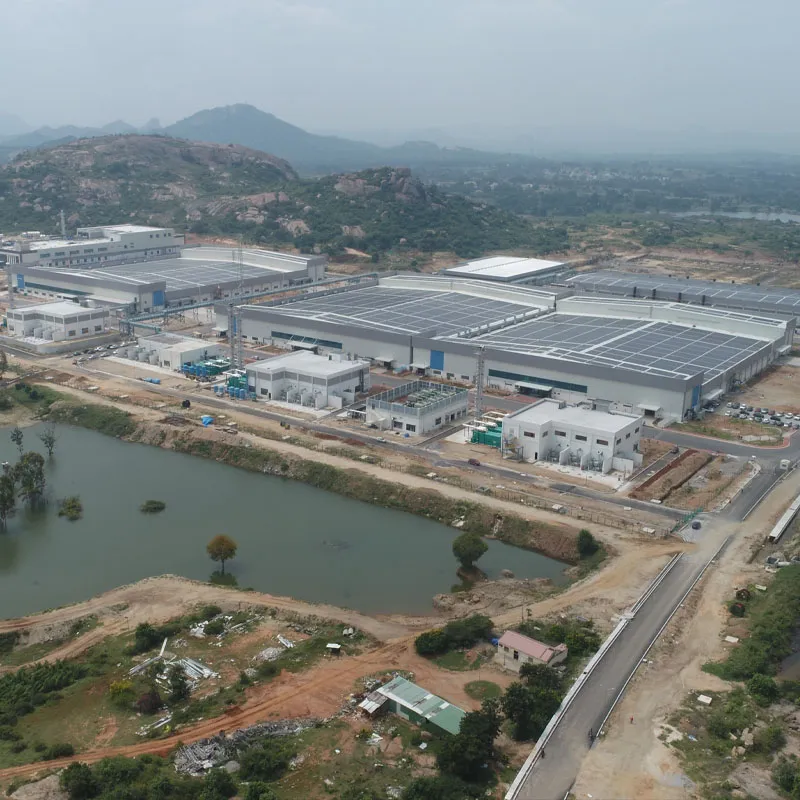
Tamil Nadu health authorities are still investigating water contamination complaints near Tata Electronics' iPhone components factory in Hosur, even after Tata said on June 16 that the Tamil Nadu Pollution Control Board had dropped further action tied to its show-cause notice. The key distinction is where the samples were taken: Tata's clean results came from inside the plant, while unresolved findings involve farmland and wells outside it.
A Reuters report republished by ETManufacturing said the health investigation remained open as of June 19, with a second round of test results still pending. That means the pollution-board track and the health-department track are not the same thing. One has been closed based on facility samples. The other remains open because off-site water complaints have not been fully resolved.
At the center of the dispute is a May 27 letter from local government medical officer Anish Parvin, reviewed but not published by Reuters, that described discharge attributed to the plant as producing a "severe foul smell" and leaving water "unsuitable for animals to drink." The letter said wastewater had pooled on nearby agricultural land and contaminated adjacent wells, and it requested an investigation by the state-run Institute of Vector Control and Zoonoses.
TNPCB issued Tata a show-cause notice on May 25 after alleging contamination of local groundwater used by farmers near the Hosur unit, which primarily produces enclosures for Apple's iPhone. Officials later said reports of imminent closure were incorrect. Tata has since said TNPCB dropped further action on that issue. The state health authority investigation is separate and remains open.
How the Hosur water dispute escalated
The dispute began with a December 8, 2025, letter to Tata from 15 farmers and a local social justice group in Ullugurukkai village. According to documents reviewed by Reuters, the farmers alleged the plant's wastewater had fouled streams, ponds and groundwater, rendering their land uncultivable.
Tata's account centers on a specific mechanical failure. A source familiar with the matter told Reuters that a pump failure at the plant's water treatment unit in December caused treated sewage to overflow from a rainwater harvesting pond into an external lake. The pump was repaired immediately, the source said.
A 2023 Tata environmental study had previously found water quality around the plant met Indian safe drinking standards, Reuters reported. That makes the current dispute narrower: what changed after that baseline, and whether the December overflow or any later water movement affected land and wells outside the plant.
Farmers first raised concerns in December 2025. TNPCB's show-cause notice followed on May 25, 2026, and health officials were still waiting on additional test results in June. The plant, which opened in 2021 and manufactures iPhone back covers and other components, has been scrutinized on two tracks: pollution-board compliance and public-health testing.
What the off-site water tests found
In April, TNPCB drew samples from two open wells near the facility, according to test results reviewed by Reuters. The samples returned total dissolved solids readings of 1,084 mg/L and 1,286 mg/L, more than double the 500 mg/L level the Bureau of Indian Standards considers acceptable for drinking water.
TDS measures dissolved minerals, salts and metals. The readings show the water exceeded India's acceptable drinking-water threshold, but they do not identify the source of the contamination.
Nidhi Paliwal, co-founder of the water nonprofit Paani Earth Foundation, reviewed the reports for Reuters and assessed the water as "unsuitable not only for human consumption but also for fisheries and wildlife."
Separately, two farmland water samples collected by health officials and sent to the district public health laboratory tested positive for E. coli, according to a May 30 lab report obtained by Reuters. E. coli is commonly used as an indicator of fecal contamination, which can come from sewage, animal waste or other sources.
The off-site results document contamination indicators near the plant. They do not, by themselves, establish that Tata's facility caused them. The source of the E. coli and elevated TDS has not been formally determined, and health investigators were still awaiting a second round of test results as of June 19.
Why Tata's tests don't answer the off-site question
Tata said on June 16 that water testing inside the facility showed TDS, COD, BOD and other parameters within legal limits, and that TNPCB had closed its review on that basis. The company also cited a 2023 environmental study as evidence of prior compliance.
The Krishnagiri district collector told New Indian Express that nearby farms had not been affected by contaminated water from the plant, while also confirming that Tata had been instructed to build a drainage canal to divert rainwater away from surrounding agricultural land. Those statements can both be true, but they leave a practical question unresolved: whether water moving off the site has been fully controlled.
The reason Tata's data and the state's off-site findings do not settle each other is straightforward: they measured different locations. Tata's samples were drawn from inside the plant. The E. coli results and elevated TDS readings came from external wells and farmland.
What farmers say changed near the plant
Farmer Gurumoorthy V, 40, told Reuters he once cultivated tomatoes, beans and rice on land near the plant. "If we sow seeds with this water, they sprout and then they wither and die," he said. Farmers collectively allege the contamination has rendered portions of their land infertile.
Skin complaints are also part of the documented record. Parvin's May 27 letter referenced reports of skin-related health issues among residents, though Parvin told Reuters no cases had been clinically established as of that date.
Farmer P. Pushparaj told New Indian Express the community has been raising the issue since December and believes the company is downplaying it.
Why Apple's India supply chain is part of the story
The dispute reaches beyond one factory because Tata is central to Apple's manufacturing shift into India. Counterpoint Research, cited by Reuters, projects India will produce 26% of the world's iPhones in 2026, up from 6% four years earlier. That puts the Hosur investigation inside a larger question about supplier oversight as Apple expands production in India.
Apple says its Supplier Code of Conduct covers environmental standards, and that supplier assessments can include documentation reviews, site walkthroughs and unannounced visits. Apple has not publicly commented on the Hosur investigation.
The unresolved question is whether Tata's internal monitoring and state oversight can detect and address any impacts beyond the plant boundary. The second-round health authority tests will be the next major signal.
What the record still doesn't prove
The record as of June 19 is clear on several points: off-site wells tested in April showed TDS readings above India's acceptable drinking-water threshold; farmland water samples returned positive E. coli results in late May; and a government medical officer described foul odors and water unfit for animal use in a letter reviewed by Reuters.
What the record does not yet resolve is the source of that contamination. Tata's internal compliance data, the district collector's public statements and the off-site evidence do not answer the same question. Rajesh Kumar C's confirmation that the health probe remains ongoing leaves the most important issue unsettled.
Two developments will determine how far the case goes: the second-round health authority test results, and whether those findings trigger fresh action by Tamil Nadu authorities. Until then, the evidence shows off-site water-quality concerns, not a proven source.











Comments
Be the first, drop a comment!