





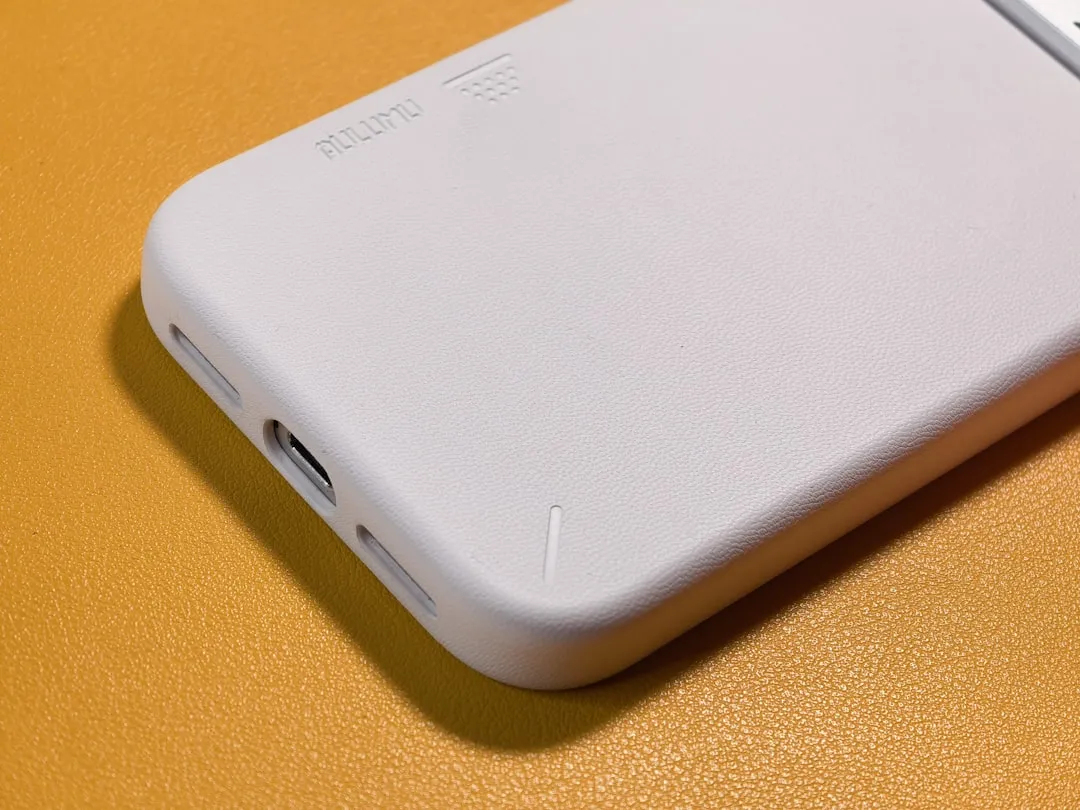
Aulumu M10 3-in-1 MagSafe Battery: What the Listing Doesn't Tell You
Editor's note: No independent research data was available for this report. All claims are drawn exclusively from Aulumu's public product listing. No external market figures, technical benchmarks, or third-party specifications have been verified for this piece. Figures marked TBC were not confirmed on the product page at time of writing. This is a product-listing assessment, not a review.
Aulumu has published a product listing for the M10, a battery pack described as capable of wirelessly charging iPhone, Apple Watch, and AirPods simultaneously in a pocketable form factor. The listing is live. The specifications needed to evaluate that claim are not in it.
This is not a review. No unit was tested, and no independent performance data has been published for this product as of this writing. What follows is a direct account of what Aulumu's listing says, what it skips, and what that means for anyone trying to decide whether to buy one.
What Aulumu's listing actually claims
The M10 is described as housing three wireless outputs: a MagSafe-aligned coil for iPhone, an embedded coil for Apple Watch, and a Qi pad for AirPods. The listing states these run simultaneously. The iPhone coil is described as "MagSafe-compatible."
That phrase is doing real work without defining its terms. "MagSafe-compatible" can describe two entirely different categories of accessory. One carries Apple's Made for MagSafe certification and is rated to deliver up to 15W to iPhone 12 and later. The other uses compatible magnets without that certification and tops out at 7.5W, roughly half the output. Aulumu's listing uses "MagSafe-compatible" without specifying which category the M10 falls into, and nothing else on the page resolves it.
The gap matters in practice. At 7.5W, an iPhone charges substantially slower than at 15W. For a product whose pitch is emergency top-up across three devices, the ceiling on iPhone charge rate is not a fine-print detail. It is one of the three or four numbers a buyer needs before making a decision.
The simultaneous output claim appears in product copy. It carries no per-output wattage figures, no thermal behavior notes, no technical qualification of any kind.
What the listing leaves out
The listing does not disclose: rated capacity in mAh, weight, physical dimensions, retail price, pack recharge time, per-output wattage figures, or Apple Watch charge rate. For a product whose core pitch is simultaneous three-device wireless charging, these are the numbers that make or break any practical evaluation.
Rated capacity is the most consequential omission. Without a confirmed mAh figure, there is no basis for estimating whether the M10 can meaningfully serve all three devices in a single session. A pack with a small cell might fully charge a Watch and AirPods while returning very little to an iPhone. A larger cell changes that picture entirely. The listing does not say which it is.
Inductive energy transfer compounds this uncertainty. A portion of the pack's stored capacity is lost as heat during wireless transfer rather than delivered to the device, and that gap grows across three simultaneous loads. Without a rated mAh figure as the starting point, none of that math is possible.
Retail price is also absent. A buyer cannot weigh the M10 against a wired power bank, a competing wireless pack, or a combination solution without knowing what Aulumu is charging for it. Weight and dimensions go unstated for a product marketing itself on pocketability. Pack recharge time goes unmentioned entirely. Apple Watch charge rate is similarly absent, and not all portable Watch coils perform equivalently.
Before buying: what the listing still can't answer
The simultaneous output claim is the M10's core differentiator, and it is the claim least supported by what the listing actually shows. Running multiple wireless coils under concurrent load generates heat. Heat can suppress actual charge rates below stated figures, sometimes significantly. Whether the M10 handles sustained three-device output without thermal throttling is the central performance question, and the listing does not address it.
Some multi-device packs deliver genuine concurrent output. Others cycle between devices in sequence, prioritizing one while the others wait. The two behaviors produce very different real-world results. A pack that cycles sequentially might still charge all three devices over time, but the time-to-useful-charge across all three is substantially different from a pack running all three coils concurrently. Aulumu does not clarify which behavior the M10 exhibits.
Three questions would resolve the most critical uncertainties. First: does the M10 carry Made for MagSafe certification, or is the iPhone coil operating on compatible magnets without it? The answer determines the effective iPhone charging ceiling. Second: does the M10 deliver to all three devices concurrently under real load, or does it cycle between them? Third: what are the confirmed mAh figure, weight, dimensions, and retail price? These are not supplementary detail. They are the foundation of any comparison against alternatives, and they are currently absent.
Until Aulumu supplements the listing with those figures, or an independent reviewer publishes measured performance data, buyers are being asked to evaluate a product's core claim on marketing copy alone. That is not a reason to dismiss the M10 outright. It is a reason to wait.









Comments
Be the first, drop a comment!