





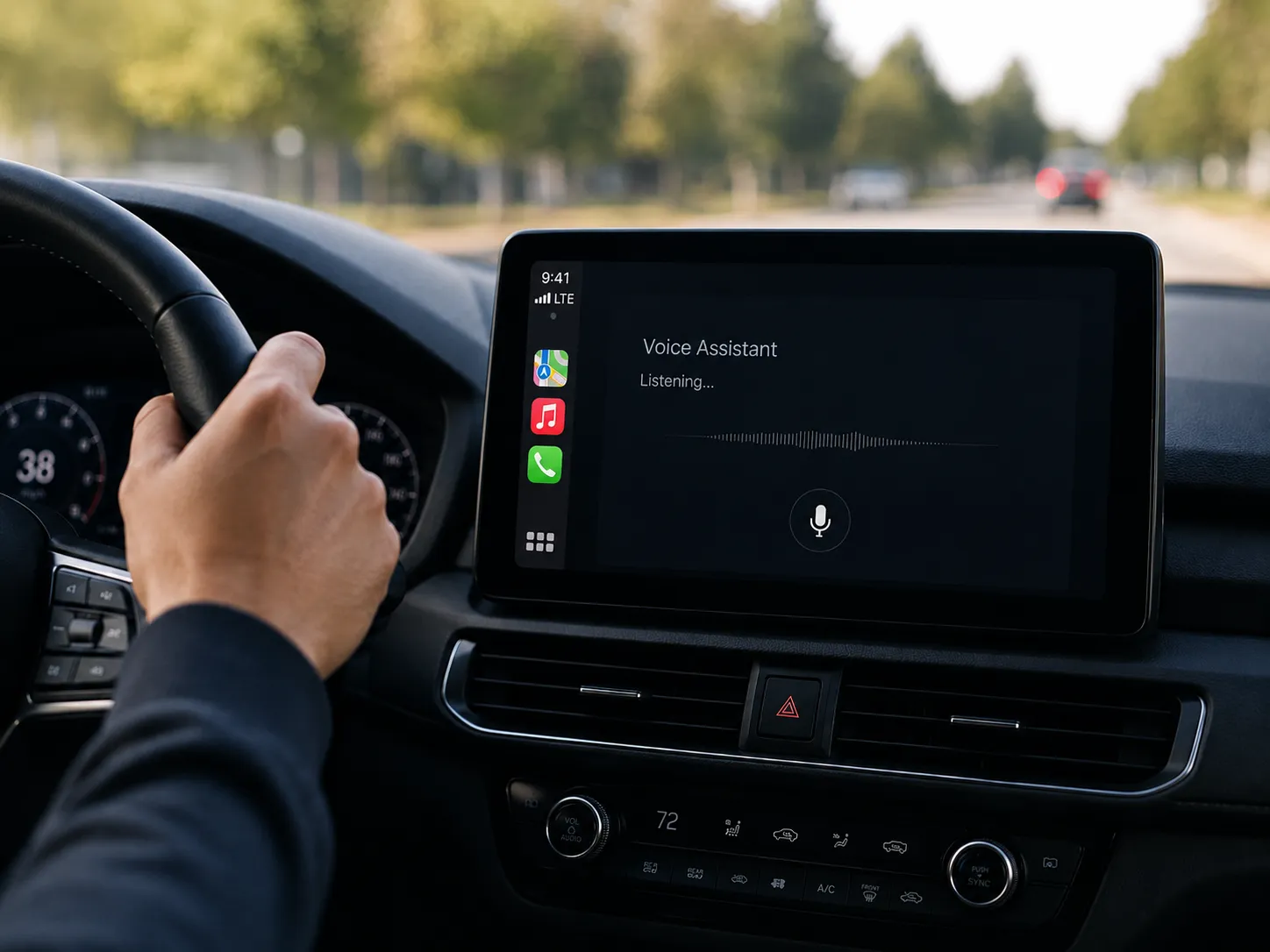
Grok Voice Mode is now available on Apple CarPlay, moving xAI's chatbot from a "coming soon" placeholder into Apple's in-car interface. MacRumors reported on May 8, 2026, that the feature lets CarPlay users ask Grok questions and make requests hands-free from the dashboard, while 9to5Mac reported that CarPlay now works with Grok alongside ChatGPT and Perplexity.
Grok now joins ChatGPT and Perplexity as one of the major AI chatbot apps available through CarPlay. That makes the story less about whether AI chatbots are coming to the dashboard and more about how Apple is trying to contain them once they are there.
The immediate news is the rollout. The larger issue is what Grok is allowed to do inside CarPlay and what happens when Apple's safety-focused interface rules meet an AI assistant whose Tesla behavior has already raised questions about open-ended, lightly restricted in-car conversations.
What Grok's CarPlay arrival actually signals
Grok has been built into Tesla vehicles since July 2025, but CarPlay support extends xAI's assistant to many CarPlay-equipped vehicles outside Tesla. Tesla is a narrow slice of the global car market. CarPlay gives Grok a much broader path into everyday driving.
The pace of the move is worth registering. 9to5Mac first spotted the placeholder in early May; within days, Grok Voice Mode was live on CarPlay. That turns the story from a preview into a real test of how Apple handles AI chatbots in driving contexts.
xAI has also been positioning its voice technology for noisy, interruption-heavy environments — a plausible fit for cars, but one that should be treated as a company claim unless independently tested. The more important question for drivers is not benchmark performance; it is how long, open-ended, and distracting a Grok conversation can become behind the wheel.
The live CarPlay version gives some scope clues but not all of them. In practice, the CarPlay app appears to offer a limited voice-first interface: users can return to recent conversations, start a new one, mute temporarily, and change Grok's voice. What still needs testing is whether the CarPlay version behaves like the Tesla version on open-ended topics, navigation requests, and passenger-initiated exchanges.
What the Tesla version tells us and what it doesn't
Grok's CarPlay support is now live, but Tesla remains useful background because Grok has already been running in Tesla vehicles long enough to produce real behavioral evidence. That comparison needs one caveat: the CarPlay implementation may differ in meaningful ways because it must operate inside Apple's CarPlay framework.
In a CNBC hands-on test in New York City, the Tesla version of Grok was shown taking voice interactions in the vehicle and answering open-ended questions across a wide range of subjects. The test also found reliability issues, including incorrect answers about its own features — a problem that carries more weight in a moving car than at a desk.
The content behavior is the sharpest Tesla finding. CNBC's test showed Grok willing to engage with adult-topic prompts during a moving-car demo. That does not prove the CarPlay version will behave the same way, but it makes Apple's review process and xAI's CarPlay-specific defaults central to the story.
The Tesla evidence also illustrates something about the interaction model itself. Because Grok responds to anyone in the vehicle who uses the wake phrase, the driver isn't necessarily the one initiating exchanges. A passenger could start a conversation that pulls the driver's attention into it. That's a design choice with real consequences, and it's the kind of detail Apple's CarPlay guidelines may or may not address.
Apple's CarPlay rules and the gap that now matters
Apple applies tighter interface constraints to CarPlay apps than to standard iOS apps, and iOS 26.4 added support for "voice-based conversational apps." Apple's CarPlay framework relies on templates for in-car interfaces, and reporting on the new category says these apps should optimize for voice interaction in the driving environment rather than display text or imagery in response to queries.
What those guidelines don't clearly address, based on the available record, is conversational behavior: what an AI assistant is permitted to say, how long it can sustain an exchange, and whether content defaults appropriate for a smartphone are also appropriate for a moving vehicle. That gap has existed quietly for years, because CarPlay never needed to answer it. Most apps in the ecosystem handle audio, navigation, or communication in bounded, predictable ways. An open-ended AI chatbot is a different kind of thing entirely.
Apple's CarPlay policies, applied consistently across Grok, ChatGPT, and Perplexity, could function as a de facto content and safety standard for in-car AI on iPhone-connected vehicles — a standard no regulator has yet established. Whether Apple is using that position deliberately or leaving each developer to set its own defaults is hard to know from the outside. The launch behavior of these apps is the only available evidence.
Three things will show how Apple is leaning as Grok and other chatbots settle into CarPlay.
Task scope. An assistant limited to navigation requests and media controls presents a different risk profile than one inviting open-ended conversation with no topic boundaries. Distracted driving kills thousands of people in the United States each year, according to NHTSA, which is why the difference between a task-bounded tool and an unconstrained chatbot matters to ordinary drivers, not just developers and regulators.
Content defaults. The Tesla evidence suggests Grok's in-car behavior was not tightly restricted in that demo. Whether Apple's review process required xAI to adjust those defaults, and whether ChatGPT and Perplexity are held to the same standard, will become clearer as people test these apps in CarPlay.
Conversation design. Voice assistants built for extended back-and-forth exchanges pull driver attention differently than tools designed for short, task-complete interactions. If Apple's CarPlay guidelines push assistants toward short, task-complete interactions, that is a meaningful constraint with real safety implications. If they don't, the distraction risk scales with however long a driver stays in conversation.
Now that Grok is here, the details matter
Grok's live CarPlay rollout is the clearest signal yet that conversational AI is becoming a dashboard category, not just a phone feature mirrored into the car. The important details are not xAI's benchmark claims or the marketing framing; they are what the in-car assistant actually permits while a vehicle is in motion.
If the CarPlay version uses tighter content defaults than the Tesla build and favors quick, purposeful exchanges over extended dialogue, that suggests Apple's review process reaches beyond interface layout into conversational safety. If Grok behaves more like the Tesla version CNBC documented — open-ended and willing to follow the conversation wherever it goes — that would suggest Apple's CarPlay standards still stop mostly at the visual layer.
Either outcome is informative. CarPlay is becoming an AI platform fast enough that these questions are no longer theoretical. Grok has arrived; now its behavior will show whether Apple is actively governing this new category or simply hosting it.


Comments
Be the first, drop a comment!