





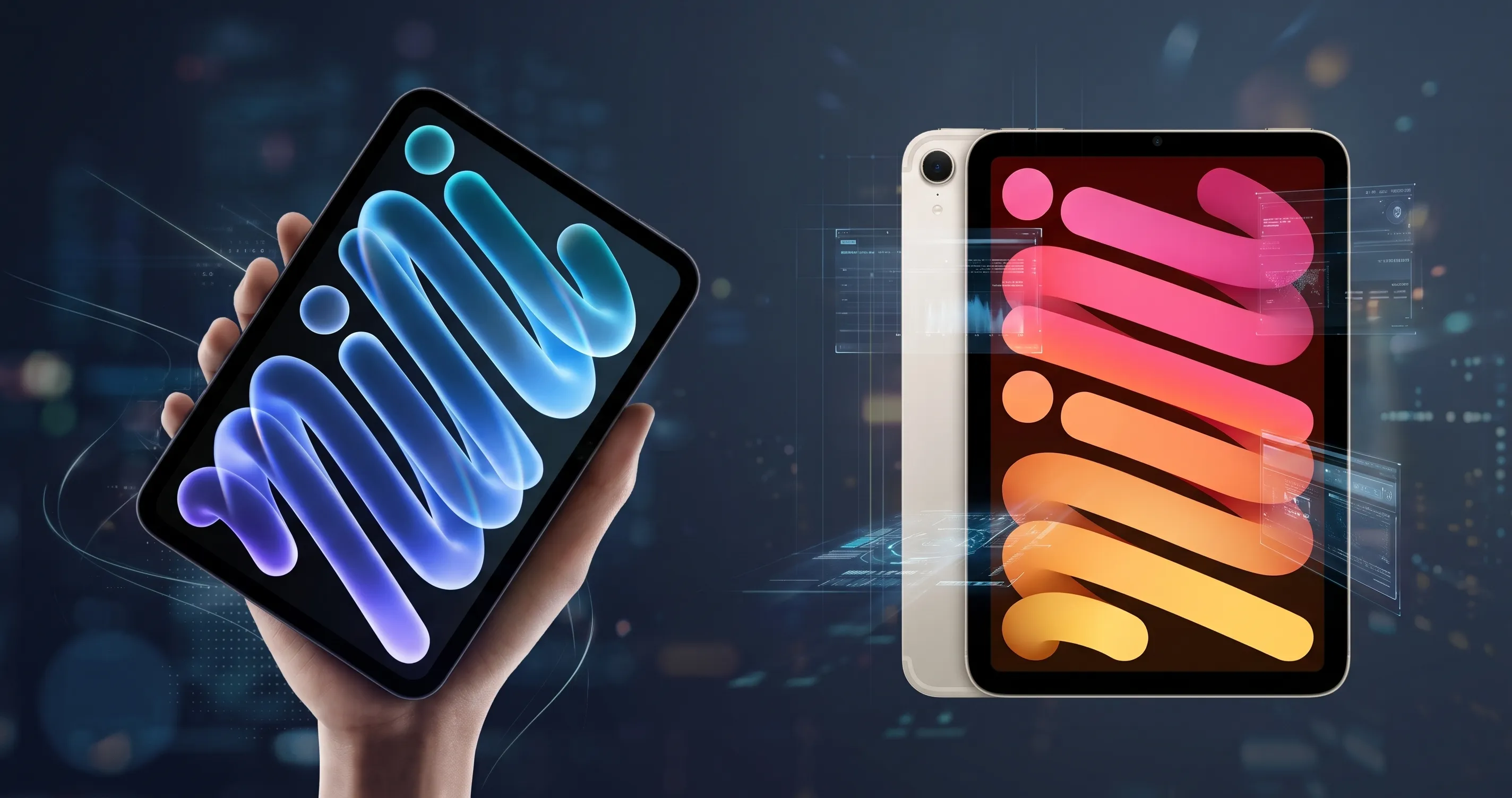
Apple's smallest tablet has finally gone OLED, but the better screen comes with a considerably higher price. The redesigned iPad mini also brings a faster A20 Pro chip, a thinner body, and something no previous mini offered: an official water and dust resistance rating.
Announced October 26, the new model starts at $699 for Wi-Fi and $849 with cellular in the United States. That's $200 above the A17 Pro's original 2024 starting price, although Apple subsequently raised that model's price. With preorders already underway and availability beginning November 6, the question is whether the upgrades are worth paying for, especially when the older mini remains a capable tablet.
The changes go well beyond the display. In its October 26 announcement, Apple outlined improvements to performance, cameras, connectivity, charging, and water resistance. Yet familiar limitations remain, including a 60Hz screen and Apple's unchanged estimate of 10 hours of battery life. Those trade-offs make the decision less straightforward than the new specifications initially suggest.
OLED vs. LCD: A better screen, but still 60Hz
The most noticeable improvement is the 8.5-inch OLED display, replacing the A17 Pro model's 8.3-inch LCD. Apple has also reduced the bezels by 24%, fitting the larger panel into a similarly compact body.
OLED controls light at the individual pixel level, producing deeper blacks and stronger contrast than a conventional LCD. Movies with dark scenes should look richer, while photos and HDR content can benefit from brighter highlights. The new screen also supports the P3 wide color gamut, retaining the broad color support of the previous generation.
Everyday brightness increases from 500 to 600 nits, while peak brightness reaches 1,200 nits when displaying HDR content. The screen can also dim to just 1 nit, making it more comfortable for reading in a dark room without keeping the display unnecessarily bright.
There's one notable omission, though. As MacRumors reported, the new mini still lacks ProMotion, leaving both generations at 60Hz. Anyone accustomed to a 120Hz iPad Pro or a high-refresh-rate smartphone won't get that same fluidity when scrolling, switching apps, or navigating menus.
Apple also offers an optional nano-texture finish to reduce reflections in bright environments. It costs an additional $100 and is restricted to the 256GB and 512GB models, bringing the least expensive nano-texture Wi-Fi configuration to $899.
For most buyers, the standard OLED panel should be enough. Nano-texture becomes more interesting for people who regularly sketch, edit photos, or work under harsh lighting, although its appearance and cleaning requirements are worth examining before paying extra.
A thinner iPad mini with protection the A17 Pro lacks
The new mini is 5.4 mm thick, down from 6.3 mm, while the Wi-Fi model weighs 255 grams instead of 293 grams. That's approximately 13% less weight, which could make a difference when holding the tablet one-handed through a long reading session.
The physical redesign also introduces IP67 water and dust resistance. Under laboratory conditions, that rating covers immersion in up to 1 meter of water for 30 minutes. It offers reassurance against accidental splashes or unexpected rain, rather than permission to deliberately use the tablet underwater.
Apple's new Acoustic Display system helps make that protection possible. Instead of conventional external speaker openings, it uses specialized audio components integrated around the display assembly. Apple promises stronger bass and clearer sound, but independent listening tests will be needed to determine whether the new arrangement sounds better than the A17 Pro's speakers.
Other changes address everyday frustrations. The 12MP Center Stage front camera now sits along the landscape edge, a more natural position for video calls when the mini rests horizontally. An Adaptive True Tone flash also improves the rear camera's document-scanning capabilities.
Wireless connectivity gets an update through Apple's N1 chip, bringing Wi-Fi 7, Bluetooth 6, and Thread. Cellular versions add the C2 modem, which Apple says can deliver up to 50% faster cellular data speeds than the previous generation, although actual speeds depend on the carrier and network conditions.
Charging is faster as well. A compatible 35W or higher USB-C adapter can charge the new mini to around 50% in 30 minutes. That adapter is sold separately; the U.S. retail box includes a 20W charger.
The A20 Pro upgrade has an important storage catch
The OLED display may attract the most attention, but the A20 Pro could be the more significant upgrade for gaming, creative applications, and demanding on-device AI tasks.
Built using a 2-nanometer process, the chip delivers up to 60% faster multithreaded CPU performance, 2.7 times faster graphics, and 4.5 times faster AI performance than the A17 Pro, according to Apple's internal testing. Those figures describe specific benchmark conditions, not guaranteed improvements in every app.
There's another detail buyers should check before choosing a storage tier. Apple's technical specifications reveal that not every A20 Pro configuration has the same processor hardware.
The 128GB and 256GB models feature a five-core CPU and one 16-core Neural Engine. The 512GB version gets a six-core CPU and dual 16-core Neural Engine, providing additional resources for heavier AI workloads. All three versions have a seven-core GPU.
The distinction matters most to users running demanding creative software or local AI models. Someone primarily browsing, streaming, reading, or taking notes may see little practical benefit from paying for the highest-capacity model solely to obtain the additional processing hardware.
Apple hasn't established how its headline AI performance figure translates across every storage configuration. Until independent benchmarks arrive, the 512GB model's additional hardware should be treated as a potential advantage for specific workloads, not a promise of dramatically faster everyday use.
Both generations support Apple Intelligence, Apple Pencil Pro, and Siri AI through compatible iPadOS updates. Siri AI remains in beta, with some features subject to device compatibility, language, region, age, and usage limits. Buyers shouldn't assume that every AI capability will behave identically across devices or be available in every market.
Should you upgrade or keep the A17 Pro?
The price difference deserves careful consideration. The A17 Pro mini launched at $499 in 2024, later increasing to $599 in June 2026. As MacRumors noted in its launch coverage, the OLED model now starts at $699, making it $100 more expensive than its predecessor's final Apple list price and $200 above the original launch price.
Battery life doesn't offer a clear reason to upgrade. Despite the new chip, capacity has fallen slightly from 19.3 Wh to 18.9 Wh, while Apple continues to advertise up to 10 hours of Wi-Fi browsing or video playback. That estimate remains to be tested independently.
The A17 Pro has been discontinued, but remaining stock could still be attractive at a meaningful discount. Buyers should compare actual retailer prices rather than relying on either tablet's original sticker price.
Three choices make the most sense:
Keep the A17 Pro if it already handles your apps, reading, games, and Apple Pencil work comfortably. The OLED panel and lighter construction are appealing, but they don't suddenly make the older tablet inadequate.
Buy the OLED iPad mini if you're upgrading from a much older model or choosing between two tablets with little difference in retail price. The screen, thinner design, water resistance, and improved connectivity make it the stronger long-term purchase on paper.
Wait for independent testing if battery endurance, speaker quality, or the performance gap between storage configurations will determine your decision. Those questions remain unanswered ahead of the November 6 release.
For existing A17 Pro owners, the sensible choice is usually to hold on unless the LCD display or physical design has become a genuine frustration. For first-time mini buyers, the OLED model is more appealing, provided the higher price fits the budget.
The new iPad mini is a substantial hardware upgrade, but it's not an automatic upgrade for everyone. A discounted A17 Pro can still do much of the same everyday work, while the $699 OLED version makes its strongest case through improvements you'll notice every time you pick it up.


Comments
Be the first, drop a comment!